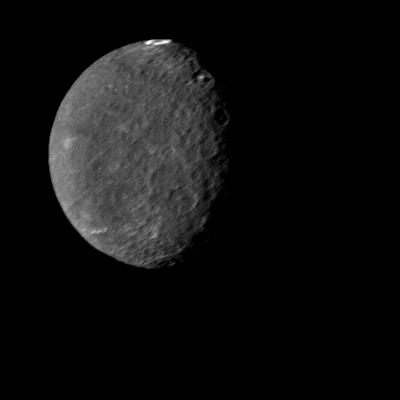
Umbriel
Uranus's darkest large moon — a heavily cratered world of ancient ice and carbon, hiding one luminous secret in the depths of Wunda crater.
Umbriel — The Dark Sprite
Umbriel is the third-largest moon of Uranus, and by far the darkest of the planet's five major classical satellites. With a diameter of about 1,170 km and a mass of roughly 1.28 × 10²¹ kg, it is a mid-sized icy world composed of approximately equal parts water ice and rocky, carbonaceous material. Its surface reflects only about 16% of the sunlight that strikes it — a somberness that inspired its name, taken from a "dusky, melancholy sprite" in Alexander Pope's 1712 satirical poem The Rape of the Lock.
Discovered on 24 October 1851 by the English astronomer William Lassell alongside its neighbor Ariel, Umbriel remained a faint telescopic point of light for 135 years. The only detailed look humanity has ever had at its surface came from a single spacecraft: Voyager 2, which swept through the Uranian system in January 1986 and revealed a battered, nearly featureless charcoal-dark globe — geologically one of the most inert worlds in the outer Solar System. Amid that uniform darkness, one feature stood out with startling brightness: a luminous ring on the floor of an equatorial impact crater called Wunda, now interpreted as a deposit of solid carbon dioxide ice.
Umbriel's extreme darkness, the origin of its carbon-rich surface coating, and the puzzle of Wunda's bright annulus remain active topics of planetary science. No spacecraft has visited Uranus since Voyager 2, but the 2023–2032 Planetary Science Decadal Survey has elevated a Uranus Orbiter and Probe to the top priority for NASA's next flagship mission, promising multiple close flybys of Umbriel in the 2040s.
Discovery and Naming
William Lassell was an English brewer who turned his considerable fortune toward building large reflecting telescopes. In 1846, using a 20-foot reflector in Liverpool, he discovered Triton, the large moon of Neptune. Five years later, on 24 October 1851, he turned the same instrument toward Uranus and found two previously unknown moons orbiting closer to the planet than the already-known Titania and Oberon. He announced finding "two moons interior to those of Herschel" — the new satellites were Ariel and Umbriel, discovered simultaneously.
The naming of both moons was proposed by the astronomer John Herschel, son of William Herschel, who had originally discovered Uranus. Following the convention of naming Uranian moons after literary characters rather than figures from classical mythology, Ariel was drawn from Shakespeare's The Tempest, while Umbriel took its name from Pope's The Rape of the Lock, where Umbriel is described as a melancholy, dusky gnome — an apt choice for the darkest moon in the Uranian system.
It is worth noting that William Herschel himself had claimed to have detected four additional moons of Uranus in the late 18th century. None of his supposed extra moons were ever confirmed, and they are now considered spurious observations. Lassell's Ariel and Umbriel therefore became the accepted third and fourth satellites of Uranus, joining Titania and Oberon. Today five major classical moons are recognised: Miranda (innermost), Ariel, Umbriel, Titania, and Oberon.
Orbit and Rotation
Umbriel occupies the middle position among Uranus's five major moons. It orbits at a mean distance of about 266,000 km from the planet's centre — beyond Ariel but well inside Titania — completing one orbit in approximately 4.144 Earth days. Its orbit is nearly circular, with an eccentricity only a few thousandths above zero, and lies essentially in Uranus's equatorial plane, with a very small inclination.
Like all five major Uranian moons, Umbriel is tidally locked: its rotational period exactly equals its orbital period, so the same hemisphere perpetually faces Uranus. This configuration has significant consequences for the surface environment. The trailing hemisphere — the face that always points away from the direction of orbital motion — is continually bombarded by magnetospheric plasma that co-rotates with Uranus. This asymmetric irradiation is thought to drive chemical changes that concentrate carbon dioxide ice on the trailing side and may contribute to the global darkening of the surface over geological time.
Umbriel orbits entirely within the Uranian magnetosphere, and instruments aboard Voyager 2 detected a distinct dip in the count of energetic charged particles at the orbital distance corresponding to Umbriel: the moon sweeps up particles as it moves, acting as a sink in the radiation belts. Because Uranus's rotational axis is tilted to about 98° relative to its orbital plane, Umbriel's poles experience roughly 42 years of continuous darkness followed by roughly 42 years of continuous sunlight during each Uranian year. This extreme seasonal cycle plays a role in how volatile ices migrate across the surface.
Physical Characteristics and Interior
With a diameter of approximately 1,170 km and a mean density of 1.54 g/cm³, Umbriel falls into the category of icy moons with a substantial rocky component. Its density is too high to be accounted for by water ice alone — pure water ice has a density of about 0.92 g/cm³ — and models suggest that rock and carbonaceous material make up roughly 40% of Umbriel's mass. The remaining mass is predominantly water ice, possibly mixed with other frozen volatiles such as carbon dioxide and, at depth, carbon monoxide or nitrogen clathrates.
The interior is believed to be differentiated: a rocky, possibly hydrated core surrounded by an icy mantle. Whether any liquid water persists at depth — making Umbriel a candidate "ocean world" — is unknown. Its ancient, geologically quiet surface does not offer the kind of evidence for present-day internal heat that might sustain a subsurface ocean, though the Uranus Orbiter and Probe mission concept includes characterising the internal structures of all five major moons, Umbriel included, as a core science objective.
Surface Geology — An Ancient, Cratered World
Umbriel's surface is dominated by impact craters of all sizes, from a few kilometres across to the largest confirmed feature, Wokolo, which spans about 210 km. The high density of craters — greater than on Ariel and Titania, and approached only by the outermost large moon Oberon — indicates a surface that has been geologically inactive for most of the Solar System's history, approximately 4 billion years. Voyager 2 provided the only close-up images ever obtained, covering roughly 40% of the surface, though only around 20% was imaged at resolution sufficient for detailed geological mapping. At the time of the encounter, Uranus was near southern solstice, so the southern hemisphere was sunlit and the northern hemisphere was in polar darkness and unobserved.
In contrast to the dramatic geology of Ariel — which is crosscut by deep graben valleys and shows extensive younger smooth plains — or the corona-covered surface of Miranda, Umbriel shows no clear evidence of large-scale tectonic activity in the imaged region. No extensive fault scarps, resurfaced provinces, or broad smooth plains have been identified. Craters on Umbriel typically possess central peaks, as expected at this size scale, but they lack the bright ejecta ray systems that adorn fresh craters on Ariel or Titania. This absence of bright rays is itself a clue: either Umbriel's surface was blanketed by dark material after the ray-forming impacts, or the ray material darkened more rapidly on Umbriel than on the other moons.
Voyager 2 photometry also identified subtle dark polygons — irregular patches tens to hundreds of kilometres across trending roughly northeast–southwest — distributed across the imaged surface, along with possible canyon-like depressions. These features are interpreted as traces of very ancient endogenic activity, perhaps the last remnants of early internal heat that was dissipated long before the present cratered landscape was established. They do not constitute large resurfaced terrains; rather, they suggest that whatever internal reshaping Umbriel underwent occurred very early and left only faint scars.
Named surface features on Umbriel are almost exclusively craters, with a nomenclature theme of dark spirits and sprites from world mythologies. Alongside the giant Wokolo, documented craters include Wunda, Fin, Peri, and Zlyden.
Wunda Crater and Its Mysterious Bright Ring
In Voyager 2's images, Umbriel's disk is so uniformly dark that the eye is immediately drawn to one feature: a bright annular ring sitting on the floor of an impact crater near the equator. This crater is Wunda, located at about 7.9° S latitude on the trailing hemisphere. Wunda is approximately 131 km in diameter, and the bright ring on its floor has an outer diameter of around 80 km and an inner diameter of about 20 km — a luminous donut against an otherwise charcoal-grey world, earning the informal nickname "the Fluorescent Cheerio" in some scientific literature.
In Voyager 2's imaging geometry, Wunda appeared near the apparent "top" of Umbriel's visible hemisphere, which led to early descriptions of a bright spot near the pole; in reality, its low equatorial latitude places it squarely in a thermally and chemically interesting zone. The ring's albedo and colour are consistent with solid carbon dioxide ice, and spectroscopic observations made from Earth and with the Hubble Space Telescope subsequently confirmed a concentration of CO₂ ice on Umbriel's trailing hemisphere, with Wunda sitting near the centre of that enhanced-CO₂ region.
Why does CO₂ ice accumulate in a ring pattern inside Wunda and nowhere else so conspicuously on the surface? The most widely accepted current explanation invokes a combination of thermophysics and Uranus's unusual axial tilt. On many bodies in the outer Solar System, CO₂ is stable at the cold poles. On Uranus's moons, because the system is tipped on its side, the poles actually receive more total sunlight over a Uranian year than the equatorial regions do; the equatorial zone becomes the long-term cold trap for CO₂. Wunda's crater geometry — a flat floor flanked by raised walls that cast shadows and create local cold spots — makes the interior a particularly efficient CO₂ condenser. Volatile-transport modelling shows that CO₂ migrating across Umbriel's surface on timescales short relative to the Solar System's age can accumulate inside Wunda, explaining both the ring morphology and the annular gap near the central peak, which may be slightly warmer.
A separate and more dramatic hypothesis proposes that the Wunda impact itself triggered cryovolcanism. In this scenario, the energy of the impact fractured the subsurface and opened pathways through which volatile-rich interior material — water-ammonia mixtures, CO₂-laden ices, or melt — ascended and erupted onto the crater floor, subsequently freezing as bright deposits. This interpretation is hypothetical and has not reached consensus; it attempts to explain why Wunda's bright material appears so much more concentrated and extensive than what diffuse volatile migration alone might account for. The Planetary Society has highlighted this hypothesis as an active area of research, noting that resolving it would require higher-resolution imaging and composition data obtainable only by a future orbiter.
The Darkness of Umbriel — An Unsolved Mystery
Umbriel's low reflectivity is one of the most puzzling aspects of the Uranian moon system. Its Bond albedo is approximately 0.10, and its geometric albedo about 0.26, making it substantially darker than Ariel or Titania and almost uniformly so across its imaged surface. NASA has stated explicitly that the process responsible for darkening Umbriel's surface remains a mystery. Four broad classes of explanation have been proposed, and current thinking suggests the true answer involves a combination of them.
The first and most favoured mechanism is radiolytic darkening by Uranus's magnetosphere. Magnetospheric plasma co-rotates with the planet and impinges preferentially on the trailing hemispheres of tidally locked moons. Energetic charged particles sputter water ice and irradiate any carbon-bearing molecules present — including methane trapped as clathrate hydrates in the ice — inducing chemical reactions that convert these materials into dark, carbon-rich residues sometimes called tholins. Over billions of years, this bombardment could have built up a dark veneer across the entire surface. This mechanism also explains why CO₂ is more abundant on the trailing hemisphere: it is a radiolytic product of carbon-bearing species under irradiation.
The second mechanism is endogenic: Umbriel's bulk composition includes rock and carbonaceous material, and the shallow interior or crust may contain carbonates or organic compounds that are themselves a source of surface carbon. Detailed modelling of CO₂ distribution on Umbriel has argued that carbon ions are not detected in the Uranian magnetosphere and that infall of exogenous carbonaceous dust is insufficient to reproduce the observed hemispheric patterns; an internal carbon source is therefore required. In this picture, radiolysis and thermal migration reshape the surface expression of an endogenous carbonaceous feedstock.
A third possibility is that Umbriel was blanketed early in its history by a global layer of dark material — either excavated by a large impact that brought dark subsurface carbonaceous rock to the surface, or deposited by early cryovolcanic eruptions that emplaced carbon-rich material over any original brighter ice. This scenario could explain the remarkable uniformity of the dark coating and the absence of bright crater rays, which would be expected if the subsurface were bright ice covered by only a thin dark veneer. Against this, the bright Wunda ring demonstrates that locally bright CO₂-rich material does exist at or near the surface, so the blanket cannot be infinitely thick.
Finally, accretion of reddish dust from Uranus's irregular outer satellites, preferentially deposited on leading hemispheres by orbital mechanics, could contribute carbonaceous low-albedo material. This is considered a secondary process rather than the dominant cause of Umbriel's extreme and uniform darkness. Spectroscopic evidence directly confirming solid organics or methane ice on the surface is still lacking; their presence is considered theoretically plausible but unproven. Resolving the dark-surface question is one of the scientific motivations for sending a dedicated orbiter to the Uranian system.
Umbriel Through Time
- 24 Oct 1851Discovery by William Lassell
English astronomer William Lassell discovers Umbriel and Ariel simultaneously using his 20-foot reflecting telescope, announcing two moons orbiting Uranus interior to the previously known Titania and Oberon.
- 1852Names proposed by John Herschel
John Herschel proposes the names Ariel and Umbriel. Umbriel is taken from a dusky, melancholy sprite in Alexander Pope's 1712 poem The Rape of the Lock.
- 24 Jan 1986Voyager 2 closest approach to Uranus
Voyager 2 makes its closest approach to Uranus at about 81,500 km above the cloud tops, conducting the only close-up survey of the Uranian moon system ever performed. More than 7,000 photographs are returned; 11 new moons and additional rings are discovered.
- Jan 1986Umbriel imaged by Voyager 2
Voyager 2 passes Umbriel at a closest approach of about 325,000 km — farther than Miranda, Ariel, Titania, or Oberon. Images reveal a uniformly dark, heavily cratered surface and the enigmatic bright ring inside Wunda crater, covering roughly 40% of the surface.
- 2016CO₂ ice model for Wunda published
A study in Icarus characterises Wunda's bright ring as an annular deposit of solid CO₂ ice, controlled by crater topography and Uranus's extreme axial tilt, which makes equatorial craters long-term cold traps for CO₂.
- 2022Uranus Orbiter and Probe named top flagship priority
The 2023–2032 Planetary Science Decadal Survey elevates the Uranus Orbiter and Probe to the highest priority for NASA's next large planetary mission, promising multiple flybys of all five major moons including Umbriel.
- 2026 (ongoing)Cryovolcanism hypothesis gains attention
Researchers publish and discuss the hypothesis that the Wunda impact may have triggered cryovolcanism on Umbriel, potentially emplacing bright subsurface volatile material on the crater floor via impact-opened fractures.
- ~2031–2032Uranus Orbiter and Probe launch window
Prime and backup launch opportunities for the Uranus Orbiter and Probe are identified as June 2031 and April 2032 respectively, with an approximately 13-year cruise time placing Uranus arrival in the mid-2040s.
- ~2044–2045Projected Uranus system arrival
If launched on schedule, the Uranus Orbiter and Probe would arrive at Uranus in the mid-2040s and conduct a multi-year equatorial tour of all five major moons, providing the first detailed science return from Umbriel since Voyager 2.
Key Findings
Voyager 2 confirmed that Umbriel's surface reflects only about 16% of incident sunlight, making it the darkest of the five major Uranian moons — substantially darker than Ariel or Titania and more uniformly so. The origin of this dark coating remains unresolved.
The 131-km impact crater Wunda hosts an ~80-km-wide bright ring on its floor, now interpreted as a deposit of solid carbon dioxide ice. The ring is the only major high-albedo feature on the entire imaged surface of Umbriel and stands out conspicuously against the surrounding darkness.
Crater counts indicate Umbriel's surface is approximately 4 billion years old, with no evidence of large-scale resurfacing or tectonic activity comparable to what occurred on Ariel, Titania, or Miranda. Among the large Uranian moons, only Oberon has a higher impact-crater density.
Spectroscopic observations from Earth and the Hubble Space Telescope detected carbon dioxide ice preferentially on Umbriel's trailing hemisphere — the side exposed to Uranus's co-rotating magnetospheric plasma — consistent with radiolytic production of CO₂ from carbon-bearing surface ices.
Voyager 2 particle instruments measured a distinct dip in the count of energetic charged particles at the orbital distance of Umbriel, demonstrating that the moon sweeps up and absorbs magnetospheric particles, acting as a sink in Uranus's radiation belts.
Modelling based on Uranus's 98° axial tilt shows that on Umbriel, CO₂ is thermally stable and long-term cold-trapped at equatorial latitudes rather than the poles — reversing the situation on more conventionally oriented worlds and explaining why Wunda, an equatorial crater, accumulates a CO₂ ice deposit.
Exploration — Past, Present, and Future
Voyager 2 remains the only spacecraft ever to have visited Uranus and its moons. Launched in 1977, it made its closest approach to Uranus on 24 January 1986, passing about 81,500 km above the planet's cloud tops. Over a period from November 1985 to February 1986, it returned more than 7,000 photographs of the Uranian system, discovered 11 new small moons and additional rings, and provided the first close-up data on all five major moons. Umbriel was among the most distant encounter targets: Voyager 2 passed no closer than about 325,000 km from it, compared with much closer passes at Miranda and Ariel, which is why Umbriel's images are lower in resolution and cover less of the surface than those of its neighbours.
Since 1986, Umbriel has been studied exclusively from Earth-based observatories and the Hubble Space Telescope, which have contributed spectroscopic detections of surface volatiles but cannot resolve geological features. No further spacecraft has been dispatched to the outer Solar System with Uranus as its primary destination.
The 2023–2032 Planetary Science Decadal Survey designated the Uranus Orbiter and Probe (UOP) the top priority for NASA's next flagship planetary mission. The baseline design calls for a launch in June 2031 (with an April 2032 backup), a cruise of approximately 13.4 years using a Falcon Heavy expendable launch vehicle, and arrival at Uranus around 2044–2045. After delivering an atmospheric probe and achieving orbit, the spacecraft would conduct a science phase lasting approximately four to four and a half years. This phase includes an equatorial tour of all five major moons — Miranda, Ariel, Umbriel, Titania, and Oberon — with multiple targeted flybys of each. For Umbriel, the UOP would provide global-scale imaging at resolutions far surpassing Voyager 2, spectral mapping of surface composition and volatile distribution, and measurements of gravity and magnetic-field interactions to constrain internal structure. Whether Umbriel harbours a subsurface ocean is one of the explicit open questions the mission is designed to address.
Several other mission concepts have been proposed. PERSEUS, a NASA/APL magnetosphere-focused orbiter, envisions a February 2031 launch and 2043 arrival. QUEST, a New Frontiers-class orbiter, proposes a 2032 launch and 2045 arrival. ESA concepts including MUSE and ODINUS and the NASA/JPL OCEANUS orbiter have also been studied, though none has advanced past proposal stage. China's Tianwen-4 programme includes a Uranus component planned as a flyby around 2045, which could image Umbriel during approach or departure but would not provide the sustained close-proximity science of an orbiter. Across all these concepts, Umbriel is always part of a five-moon package rather than a dedicated target; no mission specifically focused on Umbriel has been proposed. The substantive new science on this dark, enigmatic moon is therefore expected to arrive in the 2040s, nearly six decades after Voyager 2's fleeting glimpse.
Frequently Asked Questions
Sources
- Uranus' Moon Umbriel — Universe Today
- Umbriel — NASA Science
- Umbriel — Wikipedia
- Uranus' moons: A guide to the ice giant's strange tilted moons — Space.com
- Umbriel: Uranus' moon — NOAA Science On a Sphere
- Uranus Moons: Facts — NASA Science
- In Search of Sprites — the Discovery of Ariel and Umbriel — NASA ADS
- A Wunda-full world? Carbon dioxide ice deposits on Umbriel and other moons of Uranus — Planetary Geomorphology
- A Wunda-full world? Carbon dioxide ice deposits on Umbriel — ScienceDirect (Icarus)
- Did an impact trigger cryovolcanism on Umbriel? — The Planetary Society
- 35 Years Ago: Voyager 2 Explores Uranus — NASA
- Investigating Origins of CO₂ Ice on Uranian Moons — Eos.org
- William Lassell — Encyclopaedia Britannica
- Umbriel — Encyclopaedia Britannica
- Uranus Orbiter and Probe — NASA Science (PDF)
- Exploration of Uranus — Wikipedia