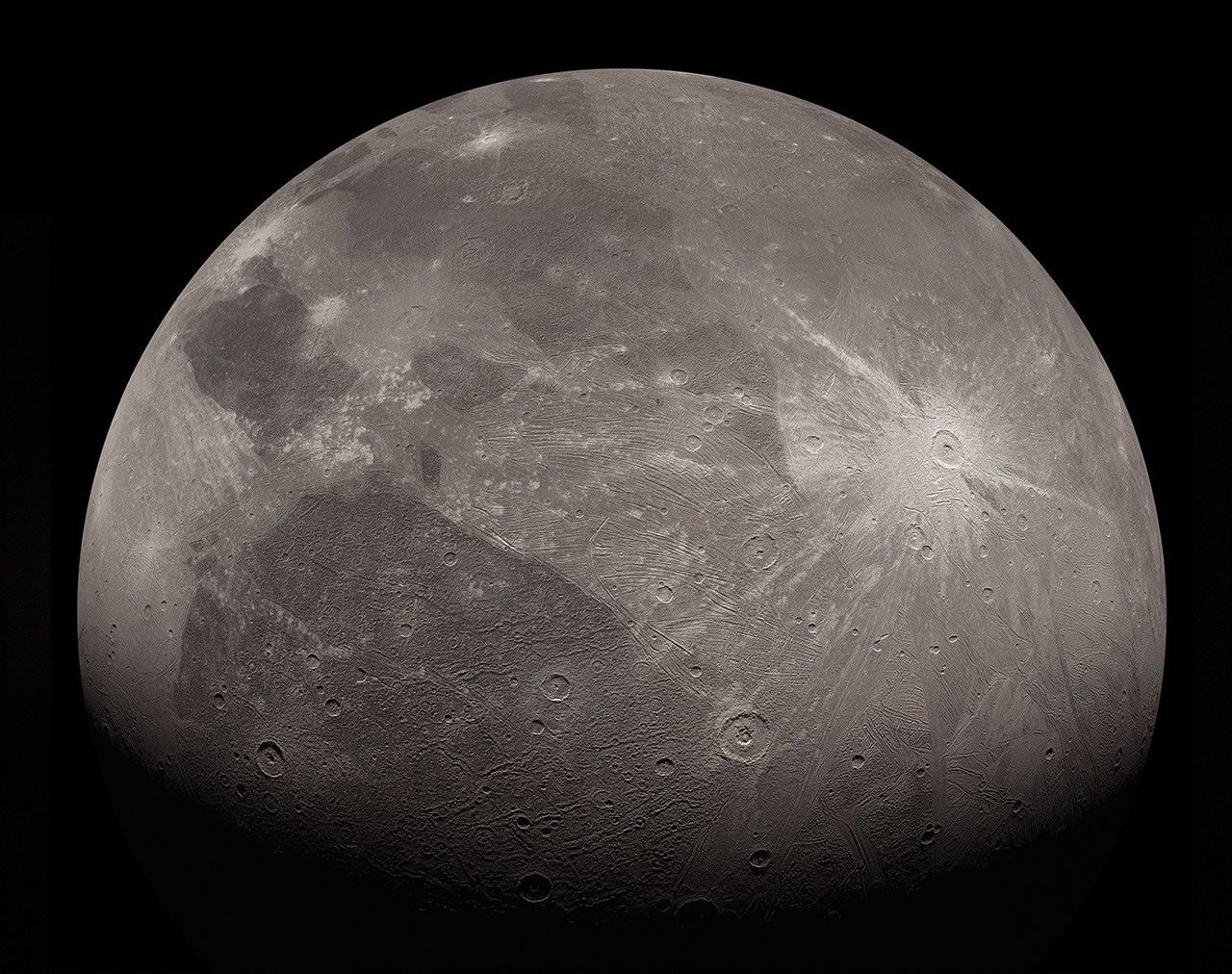
Ganymede
The Solar System's largest moon — bigger than Mercury, hiding a global ocean, and the only moon with its own magnetic field.
Ganymede
Ganymede is the largest and most massive moon in the Solar System, and the seventh moon outward from Jupiter. With a diameter of approximately 5,270 km, it surpasses even the planet Mercury in size — though it is less dense and less massive than that rocky world. Were it to orbit the Sun independently, Ganymede would satisfy the size criterion to be classified as a planet in its own right.
Ganymede is one of the four Galilean moons of Jupiter — companions to Io, Europa, and Callisto — first observed by Galileo Galilei in January 1610. Its roughly 4.5-billion-year age places it among the oldest bodies in the Solar System, and its story has proven far richer than its discoverer could have imagined. Beneath an icy, geologically complex surface lies a fully differentiated interior: an iron-rich metallic core, a silicate mantle, and an outer shell of water ice that almost certainly contains a vast global saltwater ocean holding more water than all of Earth's oceans combined.
What makes Ganymede uniquely remarkable, even among an array of extraordinary worlds, is its intrinsic magnetic field — the only one generated by any moon in the Solar System. This magnetosphere, embedded within Jupiter's far larger one, produces polar auroras in Ganymede's tenuous oxygen atmosphere, and the subtle motion of those auroras supplied the key evidence confirming the ocean beneath the ice. ESA's JUICE mission, launched in 2023, is en route to become the first spacecraft ever to orbit a moon of an outer planet when it enters Ganymede orbit in 2034.
Discovery and naming
On 7 January 1610, Galileo Galilei turned his telescope toward Jupiter and noticed what appeared to be small stars clustered near the planet. Over the following nights he tracked their movement and, by 15 January, concluded they were not background stars but satellites orbiting Jupiter — a finding that struck directly at the Earth-centred model of the cosmos. He published the discovery in his landmark work Sidereus Nuncius (The Starry Messenger) in March 1610, recording the first known detection of moons around any body other than Earth. The four satellites he observed — including Ganymede — are now collectively known as the Galilean moons.
German astronomer Simon Marius also observed the Jovian moons in 1610, likely independently of Galileo, and it is Marius to whom we owe the name Ganymede. In Greek mythology, Ganymede was a beautiful Trojan youth abducted by Zeus (the Roman Jupiter) to serve as cupbearer to the gods on Olympus — a name fitting for a moon of the king of planets. For much of the following two centuries, however, the moon was simply catalogued as Jupiter III. The mythological names only came into regular astronomical use in the 19th century.
Ganymede is approximately 4.5 billion years old, placing its formation at roughly the same time as Jupiter and the Solar System as a whole.
Size, mass, and comparative scale
Ganymede's mean radius of 2,634.1 km gives it a diameter of roughly 5,270 km — greater than that of Mercury (approximately 4,879 km) and only modestly smaller than Mars. Despite this imposing girth, Ganymede's mass of 1.4819 × 10²³ kg — about 2.5% of Earth's — is far less than Mercury's, because Ganymede is a very different kind of world: roughly half rock and half water ice by mass, giving it a mean density of only 1.936 g/cm³ compared to Mercury's 5.4 g/cm³. The consequence for surface gravity is equally dramatic: standing on Ganymede, you would feel about 15% of the pull you experience on Earth.
Its surface area of 8.72 × 10⁷ km² is about 17% of Earth's — larger than all of Earth's landmasses combined. The low mean density, the low moment-of-inertia factor of approximately 0.31 (among the lowest of any solid body in the Solar System), and gravity-field measurements all tell a consistent story: Ganymede is heavily differentiated, with mass strongly concentrated toward the centre, and its outer layers are dominated by water ice.
Internal structure
Ganymede's interior is among the most structured and layered of any icy moon. Gravity and magnetic data gathered primarily by the Galileo spacecraft reveal a classic differentiated architecture progressing from centre outward through metal, rock, and ice.
At the heart of Ganymede sits a dense metallic core, composed of iron or iron-sulfide (Fe or Fe–S), with a radius of roughly 1,500 km. The core is believed to be at least partially liquid, a condition necessary for sustaining the dynamo convection that generates Ganymede's unique intrinsic magnetic field. Surrounding the metallic core is a rocky silicate mantle, whose composition is thought to resemble L/LL ordinary chondrites — a class of stony meteorites characterised by relatively low total metallic iron and higher proportions of oxidised iron. Together, the metal core and rock mantle account for roughly half of Ganymede's mass.
The outermost approximately 700–800 km of Ganymede is a thick shell of water ice and liquid water. This shell is not a single uniform layer; thermodynamic modelling incorporating the effects of dissolved salts — particularly magnesium sulfate (MgSO₄) — indicates that the ice shell almost certainly contains one or more layers of liquid water, separated from each other by different high-pressure ice phases. The interface between the liquid ocean and the rocky mantle may lie roughly 800 km below the surface, and a convecting ocean at that depth could be up to about 40 K warmer at its base than at its upper boundary.
In 2015, Hubble Space Telescope observations of the rocking motion of Ganymede's auroral ovals provided what many scientists consider the most compelling confirmation of a global subsurface ocean. The ovals rocked less than expected if Ganymede were a solid body, and the dampening is best explained by an electrically conducting layer — a salty liquid ocean — generating an induced magnetic field that partially counters the changing influence of Jupiter's magnetosphere. This ocean is estimated to be roughly 100 km deep, beneath an ice shell approximately 150 km thick, and to contain more water than all of Earth's oceans combined. Besides water, the interior likely incorporates other volatile ices such as ammonia, and models exploring different sulfur contents in the core show how core composition shapes Ganymede's thermal evolution and its ability to sustain a dynamo.
Surface geology: a tale of two terrains
Ganymede's surface is dominated by a striking two-tone patchwork that encodes billions of years of geological history. Roughly one-third of the surface is covered by dark terrain, with the remaining two-thirds consisting of younger, brighter grooved terrain. The contrast between them is one of the most conspicuous geologic dichotomies on any body in the outer Solar System.
Dark terrain is ancient — crater density analyses suggest ages exceeding 4.0 billion years, comparable to the lunar highlands and the surface of Callisto. The low-albedo character of these regions arises not from intrinsically dark rock but from a thin lag deposit of dark non-ice material: as water ice sublimates or is sputtered away from the surface over geologic time, it leaves behind a concentration of clays, organics, and other contaminants. Beneath this dark veneer, the underlying material is predominantly bright water ice. The largest dark province is Galileo Regio, spanning roughly 3,200 km across — large enough to be conspicuous even in ground-based observations. Many dark terrain regions are laced with concentric arcuate troughs and ridges called furrows, interpreted as the remnants of enormous ancient multi-ring impact basins, analogous to the Valhalla basin on Callisto. These furrows are themselves heavily cratered, marking them among the oldest recognisable structures on Ganymede.
Bright, grooved terrain crosscuts and overlies the dark terrain, demonstrating that it formed later through extensive tectonic resurfacing. At almost any scale Galileo could resolve, this terrain is dissected by systems of parallel and sub-parallel troughs and ridges — the grooves that give it its name. These are interpreted as the expression of large-scale extensional faulting: Ganymede's icy crust was pulled apart, creating normal fault systems and fault-bounded blocks that produced the characteristic kilometre-scale topographic undulations. Whether cryovolcanism (the eruption of water or water-ice slurries) also played a role in resurfacing remains unresolved; some locally smooth, topographically low areas and flow-like features are suggestive, but no bright terrain region has been found that is completely free of tectonic lineaments, pointing to tectonism as the primary agent.
Impact craters pepper both terrains, with higher densities on the older dark terrain. Many craters on Ganymede's icy crust display shallow profiles and subdued rims: heat and pressure cause ice to flow slowly over geological time, causing topography to relax. Particularly intriguing are palimpsests — low-relief, bright circular features that are the ghosts of ancient impact craters, viscously relaxed until almost flat. Their existence implies that early in Ganymede's history the ice shell was warmer and thinner, sitting above a shallower subsurface ocean. The Gilgamesh basin in the southern hemisphere is one of the larger well-preserved impact structures, overprinted by grooves and faults. A global ring-like pattern encoded in the distribution of furrow systems has also been proposed as the signature of an enormous primordial impact that may have set the stage for Ganymede's geologic evolution.
Atmosphere and magnetosphere
Ganymede possesses an atmosphere, but calling it that stretches the everyday meaning of the word. The gas layer is so tenuous — surface pressure on the order of one millionth of a pascal, roughly 100 billion times less than Earth's sea-level pressure — that molecules almost never collide with each other. It is better described as an exosphere. Its dominant constituent is molecular oxygen (O₂), with minor contributions from atomic oxygen and possibly trace amounts of ozone and hydrogen. The oxygen is not biological in origin: it is produced when charged particles from Jupiter's magnetosphere bombard surface water ice, splitting water molecules and releasing hydrogen (which escapes to space) while oxygen remains.
Hubble Space Telescope observations in 1995 confirmed the presence of this oxygen atmosphere by detecting characteristic airglow emission, analogous to what is seen on Europa. Whether Ganymede sustains a persistent ionosphere — a layer of ionised gas associated with its thin atmosphere — remains an open question that future missions such as JUICE are designed to investigate.
Far more astonishing than the atmosphere is Ganymede's magnetic field. It is the only moon in the Solar System known to generate an intrinsic, internally driven magnetic field — a discovery made by NASA's Galileo spacecraft in 1996. The field is a dipole aligned approximately antiparallel to Jupiter's field, and its strength at the surface is roughly 1% of Earth's. The best explanation for its existence is dynamo action: convective motions in the liquid or partially liquid iron core generate electric currents, and those currents sustain the magnetic field — the same process that maintains Earth's geomagnetic field, but operating inside a body smaller than Mercury.
This intrinsic field carves out a compact magnetosphere around Ganymede, fully nested within Jupiter's much vaster one. The architecture is remarkable: at latitudes below roughly 30°, magnetic field lines are closed and trap charged particles in a radiation-belt-like region; at higher latitudes, field lines open and connect to Jupiter's ionosphere, funnelling energetic electrons and ions onto Ganymede's polar regions. The main ion species detected in the local plasma is singly ionised oxygen (O⁺), directly linking the magnetosphere to the surface ice chemistry. Galileo also detected radio emissions — described as whistling and static — generated by electrons spiralling along these field lines, a signature familiar from Earth's own radiation belts.
Where Ganymede's open field lines guide energetic particles into the thin oxygen atmosphere, the result is auroras — glowing polar ovals analogous to Earth's northern and southern lights. Hubble first imaged these auroras as two ultraviolet-bright spots near ±50° latitude, marking the boundary between open and closed field lines. More recently, Juno's Ultraviolet Spectrograph (UVS) has resolved these auroras at spatial resolutions of a few kilometres, revealing that they are not smooth ovals but fragmented into chains of patches — strikingly similar in morphology to auroral arcs on Earth, despite the near-vacuum atmosphere and embedded magnetospheric environment.
The auroras have proved to be more than a visual spectacle: they are also a diagnostic tool for what lies beneath the ice. Jupiter's magnetosphere is dynamic, and as conditions change, they should cause Ganymede's auroral ovals to rock back and forth by a predictable amount. Hubble observations led by Joachim Saur found that the rocking was significantly less than expected for a solid body. The dampening is explained by an induced magnetic field generated by a global conducting layer — a salty subsurface ocean — that partially counters Jupiter's changing field. This auroral-rocking technique turned an ultraviolet glow into one of the strongest remote detections of a subsurface ocean beyond Earth.
From telescope to orbit
- Jan 1610Galileo Galilei discovers the Galilean moons
On 7 January 1610, Galileo observes points of light near Jupiter; by 15 January he concludes they are orbiting satellites. Ganymede, the largest, is among them. Simon Marius independently observes the moons and later proposes the name Ganymede.
- Mar 1610Publication of Sidereus Nuncius
Galileo publishes his discovery of Jupiter's moons, marking the first known detection of satellites orbiting another planet and providing evidence against a strictly Earth-centred cosmos.
- Dec 1973Pioneer 10 — first close encounter
Pioneer 10 becomes the first spacecraft to encounter Ganymede during its Jupiter flyby, returning the first in-situ and imaging data of the moon.
- 1974Pioneer 11 flyby
Pioneer 11 conducts a second Jovian flyby, contributing additional but limited observations of Ganymede.
- 1979Voyager 1 and 2 — detailed reconnaissance
Both Voyager spacecraft fly through the Jupiter system in 1979, producing much sharper images. They confirm Ganymede as the Solar System's largest moon and reveal the stark contrast between its dark, heavily cratered terrain and younger grooved terrain.
- Dec 1995Galileo spacecraft enters Jupiter orbit
NASA's Galileo orbiter, launched in 1989, begins its extended mission in the Jovian system. It will conduct multiple close flybys of Ganymede, passing within 261 km of the Galilean moons.
- 1996Galileo discovers Ganymede's intrinsic magnetic field
Galileo's magnetometer detects that Ganymede possesses its own global magnetic field — the first and still only intrinsic magnetosphere found at any moon in the Solar System.
- 1995–2000Galileo maps the subsurface ocean
Analysis of Galileo's magnetometer data reveals induced magnetic signatures consistent with a global salty ocean beneath the ice. Detailed imaging maps tectonic grooves, palimpsests, and the interplay of dark and bright terrains.
- Feb 2007New Horizons Jupiter flyby
NASA's New Horizons spacecraft, en route to Pluto, flies through the Jupiter system and obtains additional images and measurements of Ganymede, refining surface mapping and providing context for Galileo's earlier high-resolution data.
- 2015Hubble Space Telescope confirms the subsurface ocean
Precise measurements of the rocking of Ganymede's auroral ovals in response to Jupiter's changing magnetosphere show the motion is damped by an internal conducting layer — a salty global ocean — providing strong independent confirmation of what the Galileo induced-field data implied.
- Jul 2016Juno enters Jupiter orbit
NASA's Juno spacecraft begins its polar orbit around Jupiter, with extended operations that include flybys of the Galilean moons. Its instruments detect mineral salts and organic compounds on Ganymede's surface, interpreted as likely ocean-derived material.
- 14 Apr 2023ESA JUICE launches
The Jupiter Icy Moons Explorer, ESA's flagship mission to the outer Solar System, launches on an Ariane 5 rocket from Kourou, French Guiana, bound for Jupiter and ultimately Ganymede.
- 19–20 Aug 2024JUICE performs historic Earth–Moon double flyby
JUICE executes the first ever back-to-back flyby of the Moon and then Earth in spaceflight history, gaining approximately 0.9 km/s and using the opportunity to calibrate all major instruments, including the JANUS camera, MAJIS spectrometer, and GALA laser altimeter.
- 31 Aug 2025JUICE Venus gravity assist
JUICE completes its Venus flyby at a closest approach of 5,088 km, gaining approximately 5.1 km/s. The mission had briefly lost contact with Earth in July 2025 due to a timer-restart anomaly, but controllers at ESA's ESOC recovered the spacecraft after roughly 20 hours.
- 2031 (planned)JUICE arrives in the Jupiter system
JUICE enters the Jovian system and begins a multi-year tour including flybys of Europa, Callisto, and Ganymede, with the first Ganymede flyby planned for 2031.
- 2034 (planned)JUICE enters Ganymede orbit
JUICE becomes the first spacecraft ever to orbit a moon of an outer planet. The mission will characterise Ganymede's subsurface ocean, ice shell, interior, magnetic field, surface geology, and tenuous atmosphere from orbit.
- ~2035 (planned)End of JUICE mission — controlled impact on Ganymede
When JUICE's propellant is exhausted, gravitational perturbations will drive the spacecraft to a controlled impact on Ganymede's surface, concluding the mission.
What we have learned
Voyager data confirmed in 1979 that Ganymede, at roughly 5,270 km in diameter, is the largest and most massive moon in the Solar System — exceeding Mercury in size, though not in mass or density.
Galileo's 1996 flyby revealed that Ganymede has its own globally organised, dynamo-generated magnetic field, making it the only moon anywhere in the Solar System known to produce an intrinsic magnetosphere. The field is thought to arise from convection in a liquid or partially liquid iron or iron-sulfide core.
Galileo's induced magnetic field measurements, confirmed by the Hubble auroral-rocking technique in 2015, indicate a global layer of electrically conducting salty water beneath the ice. This ocean may be roughly 100 km deep and contain more water than all of Earth's oceans combined.
Thermodynamic modelling incorporating dissolved salts such as MgSO₄ suggests that Ganymede may host a stack of multiple liquid water layers separated by different high-pressure ice phases, with the rock-water interface lying roughly 800 km below the surface.
Precise Hubble observations found that Ganymede's polar auroral ovals rock less than expected under Jupiter's changing magnetosphere. The damping is best explained by an induced field from a global conducting ocean — turning an ultraviolet glow into one of the strongest non-contact detections of liquid water in the outer Solar System.
Juno's spectroscopic observations detected hydrated sodium chloride, ammonium chloride, sodium bicarbonate, and possibly aliphatic aldehydes on Ganymede's surface, particularly at lower latitudes. These compounds are interpreted as ocean-derived materials brought to the surface by past tectonic or cryovolcanic processes.
Juno's Ultraviolet Spectrograph resolved Ganymede's auroras at kilometre scale, revealing fragmented chains of auroral patches strikingly similar in morphology to terrestrial auroral arcs — suggesting that the fundamental plasma physics of aurora generation is shared across radically different environments.
The concentric furrow systems that pattern Ganymede's dark terrain are interpreted as the remnants of enormous ancient multi-ring impact basins. Global mapping has suggested these may encode a globe-spanning ring structure produced by a colossal primordial impact early in Ganymede's history.
Ganymede FAQ
Sources
- Ganymede (moon) - Wikipedia
- Ganymede: Facts — NASA Science
- Ganymede | Facts & Features — Britannica
- Ganymede — A guide to the largest moon in the solar system | Space.com
- Ganymede: Jupiter's Moon — NOAA Science On a Sphere
- In Depth | Ganymede — NASA Solar System Exploration
- Geology of Ganymede (LASP/University of Colorado PDF)
- Ganymede׳s internal structure including thermodynamics of MgSO₄–water — Icarus (ScienceDirect)
- The magnetic field and internal structure of Ganymede — Nature
- Interior of Ganymede — The Planetary Society
- Planetary Scientists Create Global Geologic Map of Ganymede — Sci.News
- Dark Terrain on Ganymede: Geological Mapping and Interpretation — Icarus (ScienceDirect)
- A Huge Ring-Like Structure on Ganymede — Universe Today
- Auroras on the Moon? Which Moon? — DOE Office of Science
- University of Liège Scientists Reveal Similarities Between Auroras on Earth and Ganymede — Juno Mission
- Jupiter Icy Moons Explorer (JUICE) — Wikipedia
- JUICE space probe flies by the Moon and Earth — DLR
- How Jupiter's Moon Ganymede Melted Its Core — Sky & Telescope