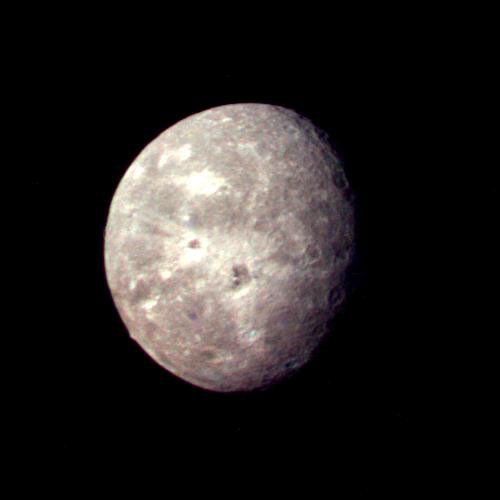
Oberon
The outermost major moon of Uranus — an ancient, cratered world of ice and rock hiding geological secrets beneath its dark and reddish surface.
Oberon
Oberon is the outermost of the five classical major moons of Uranus and the second-largest and second-most massive body in the Uranian moon system after Titania. With a mean radius of 761.4 km and a diameter of roughly 1,523 km — just under half the diameter of Earth's Moon — Oberon is a medium-sized icy satellite composed of approximately equal parts water ice and dense rocky or carbonaceous material. Its bulk density of about 1.68 g/cm³ distinguishes it from the lighter, icier moons of Saturn, pointing to a substantial silicate and carbon-rich interior.
The moon was discovered on 11 January 1787 by the British astronomer William Herschel — on the same night he found Titania — making the pair the first moons of Uranus ever identified. It orbits at a mean distance of 583,520 km from Uranus in a nearly circular, equatorial path, completing one revolution every 13.46 days. Like all of Uranus's major moons, Oberon is tidally locked, permanently presenting the same face toward the planet.
Oberon's surface is the most heavily cratered of any major Uranian moon, a geological record implying it has changed very little over billions of years. Yet Voyager 2 — the only spacecraft to have visited the Uranian system, during its January 1986 flyby — revealed unexpected complexity: large fault systems, a canyon hundreds of kilometres long, a mountain roughly 6 km tall, and numerous craters with floors coated in a mysterious dark material whose origin remains debated. These features, combined with interior models that permit a thin subsurface liquid-water layer, make Oberon one of the more scientifically intriguing worlds in the outer Solar System despite its dormant appearance.
From discovery to exploration
- 11 Jan 1787Discovery by William Herschel
Herschel detected both Oberon and Titania on the same night using a front-view reflecting telescope, making them the first two moons of Uranus ever found — six years after his discovery of the planet itself in 1781.
- 1787–1837Half a century of isolation
For approximately 50 years after their discovery, Titania and Oberon were not observed by any instrument other than Herschel's own telescope, despite both being within the reach of high-quality instruments of the era.
- Early 19th centurySpurious moon claims
Herschel later claimed to have found four additional Uranian satellites, but these detections were subsequently shown to be spurious.
- Mid-19th centuryNaming by John Herschel
William's son John Herschel proposed the names Oberon and Titania — drawn from William Shakespeare's A Midsummer Night's Dream, where Oberon is the king of the fairies and Titania his queen. This established the tradition of naming Uranian moons after Shakespearean and Alexander Pope characters.
- 1851Ariel and Umbriel discovered
Astronomers William Lassell discovered Ariel and Umbriel, bringing the total of known Uranian moons to four.
- 1948Miranda discovered
Gerard Kuiper discovered Miranda, completing the five classical major moons of Uranus.
- Jan 1986Voyager 2 flyby — sole close-up encounter
NASA's Voyager 2 became the first and so far only spacecraft to visit Uranus. Its closest approach to Oberon was approximately 470,600 km, yielding images at a best resolution of about 6 km per pixel. About 40% of Oberon's surface was imaged, and roughly 25% was mapped at resolution sufficient for geologic analysis — all in the sunlit southern hemisphere.
- 1986 onwardsEarth- and space-based follow-up
Ground-based and Hubble Space Telescope observations refined Oberon's orbital parameters and provided near-infrared spectroscopy confirming crystalline water ice at the surface. No spacecraft has returned to the Uranian system since Voyager 2.
- Nov 2023New outer irregular moon S/2023 U1
Scott Sheppard using the Magellan telescopes discovered a new ~8 km Uranian irregular moon — the first new Uranian moon in over 20 years — though unrelated to Oberon.
- Feb 2025JWST discovers S/2025 U1
A team led by Maryame El Moutamid detected a new ~10 km inner moon of Uranus using JWST NIRCam imagery, raising Uranus's known moon count to 29. Oberon remains the outermost of the five major moons.
Discovery and naming
Oberon was discovered on the night of 11 January 1787 by Sir William Herschel, the same astronomer who had detected Uranus itself six years earlier in 1781. On that single observing session, Herschel also found Titania — together they became the first two moons of Uranus ever identified, and indeed the first planetary satellites discovered since the Galilean moons of Jupiter more than a century and a half earlier. Herschel credited his detection to the performance of a custom front-view reflecting telescope, in which a single mirror directed light to an eyepiece mounted at the front of the tube. He believed this configuration rendered faint objects brighter and thus was crucial to seeing these dim points near the brilliant disk of Uranus.
For about half a century after 1787, Oberon and Titania remained exclusively the preserve of Herschel's instruments. No other astronomer could independently confirm them, not because they were beyond the reach of contemporary optics in principle, but because detailed study of dim satellites close to a bright planet demanded both patience and suitable equipment. Herschel subsequently claimed four additional Uranian moons, but these detections were later demonstrated to be spurious — a reminder of how challenging planetary-moon work was in that era.
The name Oberon was proposed by William's son John Herschel, who named both Oberon and Titania after characters in William Shakespeare's play A Midsummer Night's Dream: Oberon is the king of the fairies, Titania his queen. This Shakespearean naming convention has been maintained for essentially all subsequently discovered Uranian moons (and Alexander Pope's poetry provides names for a smaller subset), giving the Uranian system its distinctive literary identity among the planetary moon families of the Solar System.
Orbit and rotation
Oberon occupies the outermost position among the five classical major moons of Uranus. Its orbital semi-major axis is 583,520 km, and its orbit is nearly circular (eccentricity 0.0014) and very close to the equatorial plane of Uranus (inclination 0.058°). One complete orbit takes 13.463234 days, at an average speed of approximately 3.15 km/s. Because Oberon is tidally locked, its rotation period is identical to its orbital period, meaning it permanently presents one hemisphere toward Uranus.
The Uranian system has an unusual geometry that profoundly shapes conditions on all its major moons. Uranus's rotational axis is tilted by about 98° from the plane of the Solar System — essentially lying on its side — and its large moons orbit in the planet's equatorial plane. As a result, Oberon experiences extreme seasonal cycles: each pole spends approximately 42 years in continuous sunlight followed by 42 years in uninterrupted darkness as Uranus completes its 84-year circuit around the Sun. During Voyager 2's January 1986 encounter, Uranus was near its southern summer solstice, so Oberon's northern hemisphere was in complete darkness and could not be imaged.
Another consequence of Oberon's position is its relationship with Uranus's magnetosphere. Oberon's orbit carries it partly outside the magnetospheric boundary, meaning that for portions of each orbit its surface is directly exposed to the solar wind rather than being shielded by the planetary magnetic field. This space-weathering exposure is thought to contribute to surface chemistry and may partly explain the moon's reddish coloration, though the precise mechanisms remain under investigation.
Physical characteristics and interior
With a mean radius of 761.4 ± 2.6 km and a mass of (3.1104 ± 0.0749) × 10²¹ kg, Oberon is the second-largest and second-most massive moon in the Uranian system, ranking tenth largest among all moons in the Solar System. Its bulk density of 1.68 g/cm³ is notably higher than that of many Saturnian moons, which tend to be icier and less dense. This elevated density indicates that Oberon is not a nearly pure ice body but instead contains a substantial fraction of denser material.
Spectral and density analyses indicate that Oberon is composed of roughly equal parts water ice and a non-ice component consisting of silicate rock and carbonaceous material, including heavy organic compounds. This approximately 50/50 ice-to-rock ratio is consistent with its density and with the reddish, relatively dark surface observed by Voyager 2. Near-infrared spectroscopy from Earth and space-based telescopes has confirmed the presence of crystalline water ice at the surface.
Interior models — inferred from density and composition data, not from direct seismic or gravity measurements — suggest Oberon is most likely differentiated into a rocky silicate core surrounded by an icy mantle of water ice. A representative model assigns the rocky core a radius of approximately 480 km, equivalent to about 63% of Oberon's total radius, and estimates that the core contains roughly 54% of the moon's total mass. The central pressure is estimated at approximately 0.5 GPa.
An intriguing but unconfirmed possibility is the existence of a thin liquid water layer at the boundary between the rocky core and the icy mantle. Thermal evolution models suggest that if Oberon's ice contains sufficient ammonia or other antifreeze compounds, a subsurface ocean up to roughly 40 km thick could persist at temperatures around 180 K. More recent modeling has similarly proposed that residual oceans less than ~50 km thick beneath ice shells thicker than 200 km might survive in Titania and Oberon under certain initial heat-budget and composition scenarios. These are theoretical predictions; no direct observational evidence for such an ocean currently exists, and Oberon is not subject to appreciable tidal heating.
Surface: an ancient cratered world
Oberon's surface is the most heavily cratered of Uranus's five major moons, a distinction that implies it preserves the oldest exposed terrain in the Uranian system. The crater density is comparable to the ancient highland regions of Earth's Moon, and the global pattern of dense, largely unerased impacts indicates that Oberon has been geologically dormant for most of its history — its crust has not been swept clean by volcanic resurfacing or widespread tectonic reworking as has occurred on more active worlds.
The surface is dark and distinctly reddish, making Oberon the reddest of the five classical Uranian moons. The trailing hemisphere is notably redder than the leading hemisphere, a hemispheric color asymmetry that likely requires more than simple space-weathering from charged particle bombardment. One hypothesis is that reddish material spiraling inward from the outer Uranian system gradually accumulates preferentially on one side. Fresher impact sites — excavating material from below — tend to show more neutral or slightly bluish tones, revealing the contrast between the darkened surface veneer and relatively ice-rich subsurface material.
The albedo of Oberon is low overall: its geometric albedo is approximately 0.31 and its Bond albedo around 0.14. Surface temperatures average approximately 70–80 K. There is no detected atmosphere; given the very low surface gravity (0.358 m/s²) and extreme cold, any primordial volatile envelope would have been lost, and any present-day exosphere would be far below current detection thresholds.
Notable surface features and geological findings
Hamlet is the largest identified impact crater on Oberon, spanning approximately 206 km in diameter. It is prominent in Voyager 2 images and is used as a reference feature in false-color albedo maps. Like several other large craters, Hamlet's floor is coated with a dark material starkly contrasting with the brighter surrounding terrain — one of the most persistent geological puzzles on the moon.
Macbeth (approximately 203 km in diameter) and Romeo (approximately 159 km) are among the other large, named impact craters that contribute to Oberon's heavily bombarded appearance. As with Hamlet, their floors show evidence of dark material deposits.
Othello, approximately 114 km in diameter, stands out in enhanced-color images alongside Hamlet. Its dark floor is thought to represent either impact-melt material that refroze after the impact, or darker endogenic material — possibly richer in carbon or silicates — that was brought to the surface through fractures opened during the impact event.
Mommur Chasma is the most prominent tectonic feature identified on Oberon, stretching approximately 537 km. It is interpreted as a graben or scarp formed by crustal extension, comparable to terrestrial rift valleys. Its existence indicates that Oberon's crust experienced regional or global stress — possibly during early differentiation or thermal contraction — even if such activity has long since ceased.
Voyager 2 limb images revealed at least one mountain on Oberon rising approximately 6 km above the surrounding terrain. On a world otherwise dominated by flat, cratered plains, such prominent topographic relief is unusual. Its origin is not definitively established — possible explanations include fault-block uplift, accumulated impact ejecta, or a remnant of early global tectonics — but no consensus has been reached.
Many of Oberon's large impact craters have floors coated with a very dark material distinct from the surrounding icy terrain. The nature and origin of these deposits remain uncertain. Hypotheses range from cryovolcanic upwelling of dark, water-rich or carbon-rich material from the interior (analogous in concept to lunar maria), to excavation and redistribution of a buried dark layer by impacts. Some craters appear to have been flooded by material from below, hinting at past internal activity even in a world that now appears geologically dead.
Voyager 2: the only close encounter
All detailed knowledge of Oberon as a mapped world comes from a single source: NASA's Voyager 2 spacecraft, which performed its Uranus flyby in January 1986 and remains the only mission ever to visit the Uranian system. Prior to that encounter, Oberon was little more than a slowly moving point of light whose orbital properties were reasonably well established but whose physical nature was largely speculative.
During the flyby, Voyager 2's closest approach to Oberon was approximately 470,600 km — a far more distant pass than the spacecraft made at some other moons. The best image resolution achieved was approximately 6 km per pixel. Because Uranus was near its southern summer solstice, only the southern hemisphere of Oberon was sunlit; the northern hemisphere was plunged into decades-long polar night and was entirely invisible to the cameras. In total, Voyager 2 imaged about 40% of Oberon's surface, but only roughly 25% was imaged at a resolution adequate for meaningful geological mapping.
Within those limitations, Voyager 2's data were transformative. The mission revealed a heavily cratered world with multiple named impact basins, cross-cutting fault systems suggesting past tectonic extension, and the unexplained dark material coating crater floors. It also simultaneously expanded Uranus's known moon count by discovering ten additional, smaller satellites that had been undetectable from Earth. No follow-up mission has since returned to the Uranian system, meaning the unmapped 60% of Oberon's surface — including its entire northern hemisphere — has never been seen at close range.
Oberon in context: the Uranian moon system
The five classical major moons of Uranus — Miranda, Ariel, Umbriel, Titania, and Oberon — occupy a fascinating middle ground in the Solar System's diversity of worlds. They are larger than most irregular satellites but smaller than the great moons of Jupiter and Saturn. Oberon, as the outermost of the five and the second largest after Titania, sits at the edge of this family. Its density is intermediate and its surface the most ancient, suggesting it experienced less internal reworking than Ariel or Titania but more than the extremely dark and similarly ancient Umbriel.
The broader Uranian system now comprises 29 known moons following the detection of S/2023 U1 — a roughly 8 km outer irregular moon found with the Magellan telescopes in November 2023 — and S/2025 U1, an approximately 10 km inner moon detected in JWST NIRCam images in February 2025 by a team led by Maryame El Moutamid. Neither of these tiny new moons is related to Oberon; they reflect the ongoing work of characterising the outermost and innermost reaches of the system. The five major moons, Oberon included, retain their status as the principal large bodies and the primary scientific targets for any future Uranus orbiter mission.
Multiple Uranus-orbiter mission concepts under discussion for the 2030s–2040s include close flybys of Oberon as priority science objectives. Such a mission would refine Oberon's gravity field (constraining its interior structure), image the unseen northern hemisphere, search for any tenuous exosphere, and characterise the dark crater-floor material through near-infrared spectroscopy. As of current literature, however, these concepts remain in the proposal or pre-phase-A stage and no mission has been formally approved and built.
Frequently asked questions about Oberon
Sources
- Uranus's Moon Oberon — Universe Today
- Oberon (moon) — Wikipedia
- Uranus — Moons, Rings, Atmosphere | Britannica
- Oberon | Moon, Uranus, Size, Surface, Craters & Facts — Britannica
- Oberon — NASA Science
- Oberon — NOAA's Science On a Sphere
- Uranus' moons: A guide to the ice giant's strange tilted moons — Space.com
- Jan. 11, 1787: William Herschel discovers two moons of Uranus — Astronomy.com
- Oberon (moon) — Research Starters, EBSCO
- Compositions and Interior Structures of the Large Moons of Uranus — AGU Journals
- Librations and obliquity of the largest moons of Uranus — arXiv
- New moons of Uranus and Neptune announced — Carnegie Science
- New Moon Discovered Orbiting Uranus Using NASA's Webb Telescope — NASA Science
- SwRI-led Webb Telescope survey discovers new moon orbiting Uranus — SwRI
- The Oberon Moon: Key Facts and More — ThePlanets.org