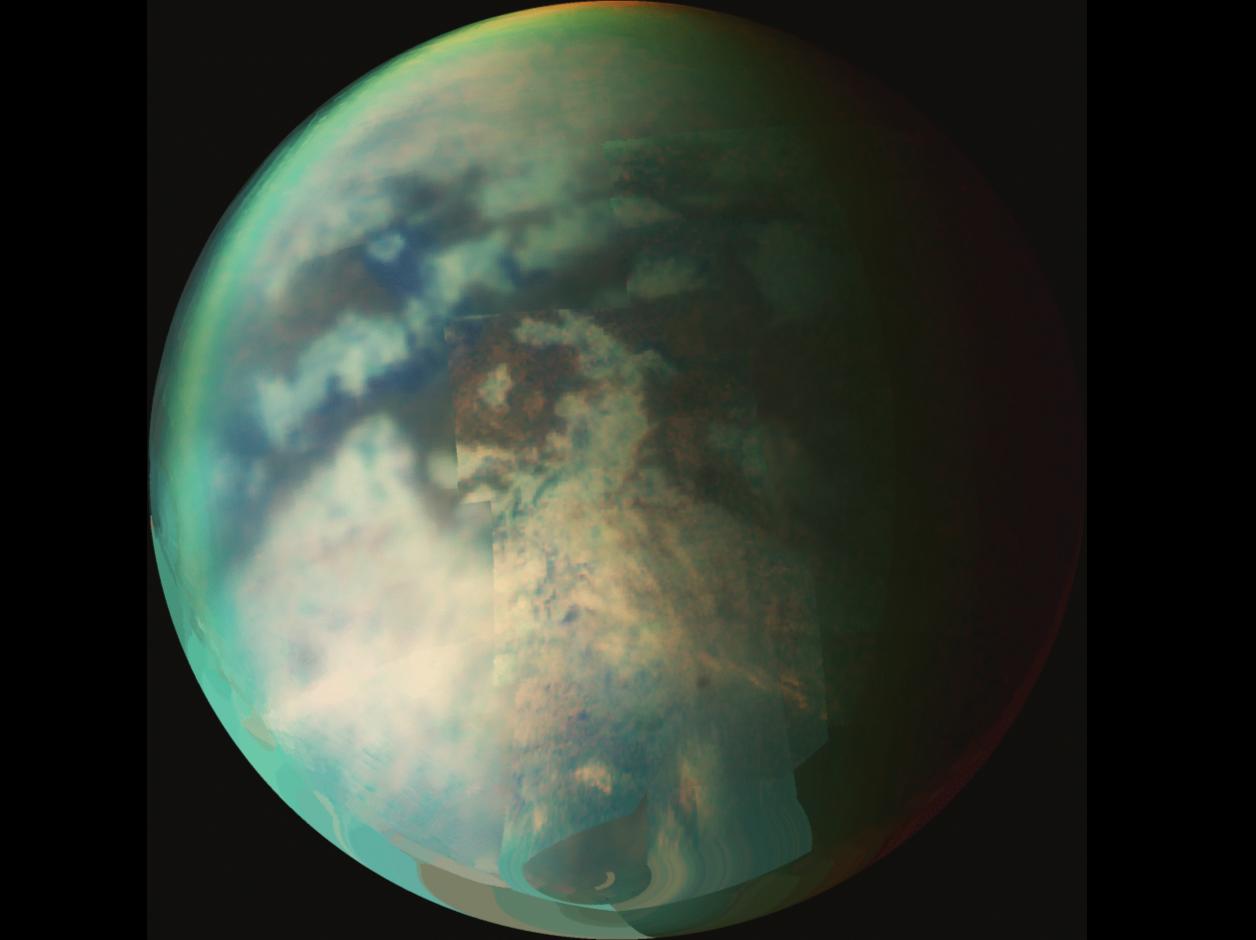
Titan
Saturn's largest moon — the only world beyond Earth with stable surface liquids, a dense nitrogen atmosphere, and a methane-based weather cycle.
Titan
Titan is the largest moon of Saturn and the second-largest moon in the Solar System, surpassed only by Jupiter's Ganymede. With a mean radius of 2,574.7 km, Titan is larger than the planet Mercury and about 48% larger across than Earth's own Moon. Yet what sets Titan apart from every other moon — and from nearly every other body in the Solar System — is not its size but its complexity. It is the only moon known to possess a dense, global atmosphere, the only world besides Earth with stable liquid bodies on its surface, and the only place other than Earth where an active, planet-wide weather cycle continuously reshapes the landscape.
That weather cycle is driven not by water but by methane. Clouds of methane condense and rain onto a surface of water-ice bedrock, carving rivers, filling polar seas, and building vast dune fields of organic sediment before evaporating back into an orange-tinted sky. The atmosphere itself — dominated by nitrogen, with several percent methane — is denser at the surface than Earth's own air, pressing down at roughly 1.5 times Earth's sea-level pressure. Sunlight and energetic particles split nitrogen and methane high in the stratosphere, initiating a cascade of photochemical reactions that produces hundreds of complex organic molecules and coats the moon in a permanent global haze of reddish-brown aerosols called tholins.
Titan was discovered on 25 March 1655 by Dutch astronomer Christiaan Huygens. For more than three centuries it remained little more than a bright speck orbiting Saturn, its surface invisible beneath the haze. The Cassini–Huygens mission (2004–2017) transformed that picture entirely: an orbiter that flew past Titan more than a hundred times and a probe that descended through the atmosphere and landed on the surface in January 2005. The picture that emerged is of a world whose chemistry may mirror the prebiotic Earth, making it one of the highest-priority targets in the search for life's origins. NASA's Dragonfly rotorcraft mission, confirmed and targeting launch no earlier than July 2028, will fly across Titan's surface to examine those questions in person.
Interior structure and bulk composition
Titan's mean density of 1.88 g/cm³ — roughly halfway between pure water ice (0.92 g/cm³) and silicate rock (around 3 g/cm³) — reveals a world built of approximately equal parts rock and ice. The bulk composition is estimated at roughly 40–60% silicate rock with the remainder mostly water ice and other volatiles. This intermediate density, combined with gravity and tidal-response data returned by Cassini, points to a differentiated interior: a rocky core surrounded by layers of high-pressure ice and, critically, a global subsurface ocean of liquid water.
The existence of that ocean is inferred from the way Titan flexes under Saturn's gravitational tides. A rigid, fully frozen interior would flex less than what Cassini measured; the data are consistent with a layer of liquid water, likely mixed with ammonia or salts that depress its freezing point, sandwiched between ice layers beneath the outer crust. This internal ocean is entirely separate from the methane-ethane lakes and seas visible at the surface and raises the intriguing possibility that Titan harbors two chemically distinct liquid environments: a hydrocarbon realm on the surface and a water realm underground, each with its own potential relevance to the origins of life.
Titan orbits Saturn in a synchronous lock, completing one rotation every 15.945 days — the same period as its orbit, so the same hemisphere always faces Saturn. Its shape is slightly oblate, consistent with hydrostatic equilibrium under its rotation and tidal forces. The moon lies about 1.2 million km from Saturn and approximately 9.5 AU from the Sun, receiving only about 1% of the sunlight that reaches Earth.
Atmosphere: structure, composition, and chemistry
Titan's atmosphere is its most immediately distinctive feature. With a surface pressure of approximately 1.45–1.5 bar — roughly 50% higher than Earth's — it is denser than Earth's air despite Titan's gravity being only about 14% of Earth's. This is a consequence of Titan's cold temperature: at around 94 K, gases are compressed into a denser column. The atmosphere extends more than 1,000 km above the surface before fading into a tenuous ionosphere and exosphere.
By composition, the atmosphere is dominated by molecular nitrogen (N₂), which accounts for roughly 95–98% of the total, depending on altitude and measurement. Methane (CH₄) makes up most of the remainder — approximately 5–6% near the surface and about 1.4–1.6% in the stratosphere. Molecular hydrogen (H₂) contributes about 0.1%. These three gases are accompanied by a remarkable zoo of trace species: simple hydrocarbons including ethane, propane, acetylene, and ethylene; nitrogen-bearing organics such as hydrogen cyanide (HCN), cyanoacetylene (HC₃N), acetonitrile (CH₃CN), and cyanogen (C₂N₂); carbon monoxide (CO) and carbon dioxide (CO₂); and in the upper atmosphere, large positive and negative organic ions exceeding 10,000 atomic mass units.
The engine driving this chemical complexity is photochemistry. High in the upper atmosphere, above roughly 800–1,000 km altitude, solar ultraviolet radiation and energetic charged particles from Saturn's magnetosphere break apart N₂ and CH₄ molecules into reactive radicals and ions. Because the environment is largely anoxic — oxygen is scarce — these fragments do not rapidly oxidize and instead recombine into ever-larger organic molecules. The resulting cascade builds from simple two-carbon species up through polycyclic aromatic hydrocarbons and complex nitrile chains. Cassini detected vinyl cyanide (C₂H₃CN) in Titan's atmosphere via the ALMA radio telescope, a molecule that under Titan surface conditions could in principle assemble into membrane-like vesicles in liquid methane, analogous to cell membranes in water.
These growing organic particles eventually coagulate into nanometer-sized aerosols that drift downward and aggregate into the visible haze that gives Titan its characteristic orange color. This material, generically called tholins, forms a main stratospheric haze layer roughly 100–210 km above the surface, with additional detached layers at other altitudes. Tholins rain out continuously onto Titan's surface, blanketing it in a layer of complex organics and supplying chemical feedstock for reactions at the surface and in hydrocarbon lakes. The process makes Titan, in effect, a vast natural laboratory running prebiotic chemistry at planetary scale — an experiment that has been ongoing for billions of years.
Maintaining this atmospheric system requires a continuous supply of methane. Solar UV destroys methane on timescales of tens to hundreds of millions of years, far shorter than the age of the Solar System, implying that methane must be replenished. Proposed sources include cryovolcanic outgassing from the interior and the release of methane trapped in clathrate ices. The origin of Titan's nitrogen is similarly debated: isotopic evidence points either to primordial ammonia ice photolyzed into N₂ or to molecular nitrogen trapped directly from the protosolar nebula. Resolving these questions about atmospheric replenishment remains one of the central open problems in Titan science.
Surface: a world shaped by methane
Titan's surface sits at roughly 94 K — close to methane's triple point, where solid, liquid, and gaseous methane can coexist. This coincidence is what makes Titan's active methane cycle possible and gives it a geological character unlike anything else in the Solar System except Earth. The surface itself is composed of water ice acting as bedrock, overlain by organic sediments derived from the atmospheric haze.
The most geologically dynamic regions are the poles. Cassini's radar first detected lakes of liquid hydrocarbons in Titan's north polar region in July 2006, and by 2007 the existence of large seas and many smaller lakes had been confirmed. These bodies consist primarily of liquid methane and ethane with dissolved nitrogen and trace hydrocarbons. The largest seas span several hundred kilometers across and reach depths of several hundred meters, fed by extensive dendritic river channel networks that drain the surrounding highlands. Smaller lakes tend to have rounded outlines, steep walls, and relatively flat surroundings — a morphology consistent with dissolution processes analogous to terrestrial karst sinkholes, where soluble material is chemically removed by the liquid. At the rainy polar latitudes, models suggest it takes about 50 million years for such dissolution to carve a basin 100 meters deep; at the drier lower latitudes, the timescale lengthens to around 375 million years.
Rivers and channels crisscross Titan's landscape at all latitudes, some carved into deep canyons reaching approximately 550 meters (about 1,800 feet) in depth, with liquid hydrocarbons flowing along their floors. These channel networks transport organic sediment from the uplands toward the polar seas, and in some regions the evidence suggests that rising liquid levels have flooded pre-existing river valley networks to create the current sea coastlines — a process MIT shoreline modeling indicates is shaped significantly by wave-driven erosion from methane-ethane waves.
The equatorial regions tell a very different story. Instead of lakes, they are dominated by vast dune fields of organic sand — likely complex hydrocarbons — shaped into linear dunes by Titan's winds. These sand seas cover large expanses of the low-latitude terrain and represent the most extensive deposit of organic material at the surface. Between the equatorial dunes and the polar seas lie broad plains and hummocky, mountainous terrain built of water-ice bedrock. Impact craters are relatively rare compared to airless bodies in the Solar System, indicating that Titan's surface is geologically young, continually reshaped by erosion, deposition, and possibly cryovolcanic activity. The first global geologic map of Titan, constructed from Cassini radar and imaging data, confirmed this diversity of terrain types and the ongoing activity of the methane cycle in modifying all of them.
Cassini data also revealed candidate cryovolcanic features — structures that may represent eruptions of water-rich material from the interior — though their interpretation remains debated and no cryovolcanism has been definitively confirmed. Models suggest that water from Titan's internal ocean could in principle be transported upward and mix with surface hydrocarbons, creating chemically interesting environments at the interface. Some lake basins and surface features show seasonal changes tied to Saturn's approximately 30-year orbital period, with polar lakes filling and draining as Titan's climate shifts between hemispheric seasons — direct evidence that the methane cycle is active and ongoing today.
Astrobiological significance
Titan occupies a special position in astrobiology not because life has been detected there, but because it offers two independent potential environments for prebiotic chemistry and, conceivably, biology. The first is the surface and atmosphere: a cold, anoxic, nitrogen-methane system rich in organic molecules, hydrocarbon liquids, and continuous energy input from photochemistry. The second is the subsurface ocean: a liquid-water environment, probably laced with ammonia, that more closely resembles habitats considered plausible for Earth-like life.
The atmospheric chemistry is particularly compelling from a prebiotic standpoint. Titan's nitrogen-methane atmosphere is widely considered analogous to hypothesized conditions on early Earth before the rise of atmospheric oxygen — a period during which the building blocks of life are thought to have accumulated. The molecules Cassini and ground-based telescopes have detected on Titan include hydrogen cyanide, cyanoacetylene, acetonitrile, and other nitriles that are classic feedstocks in models of how amino acids and nucleobases form in aqueous environments. Vinyl cyanide, detected via ALMA, is of particular interest because theoretical work suggests it could form membrane-like structures in liquid methane, raising the speculative but scientifically interesting possibility of a hydrocarbon-based biochemistry operating under Titan's cold conditions.
However, important caveats apply. The very low surface temperature — around 94 K — drastically slows chemical reaction kinetics, making the development of complex biochemistry in surface hydrocarbon liquids a formidable challenge. Oxygen-bearing organics such as methanol and formaldehyde have not been detected; oxygen appears only in simple molecules like CO and CO₂. Any life operating in liquid methane would need to be radically different from anything known. The subsurface ocean represents a more familiar environment for life as we know it, but it is far removed from the energy and chemical gradients available at the surface. These open questions are among the primary science drivers for the Dragonfly mission.
From discovery to Dragonfly
- 25 March 1655Christiaan Huygens discovers Titan
Dutch astronomer Christiaan Huygens observes a large moon orbiting Saturn through a ~50× refracting telescope he and his brother Constantijn had constructed. It was the first known moon of Saturn and only the sixth moon discovered in the Solar System.
- 1655–1656Discovery announced
Huygens publishes the discovery in his Latin pamphlet De Saturni Luna Observatio Nova. His later work Systema Saturnium (1659) combines the announcement of Titan with his explanation of Saturn's rings.
- 1847Named 'Titan'
British astronomer John Herschel proposes systematic mythological names for Saturn's moons and assigns the name Titan to Huygens' 1655 satellite, after the Titans of Greek mythology.
- November 1980Voyager 1 flyby
NASA's Voyager 1 targets Titan for a close flyby during its Saturn encounter. Measurements reveal a substantial atmosphere richer in nitrogen than Earth's, but the dense haze prevents visible-light imaging of the surface. This spurs interest in a dedicated mission.
- 1981Voyager 2 passes Saturn
Voyager 2 flies through the Saturn system but does not approach Titan as closely, its trajectory preserved for continuing on to Uranus and Neptune.
- 1997Cassini–Huygens launched
NASA, ESA, and ASI launch the Cassini Saturn orbiter carrying ESA's Huygens atmospheric probe, named in honor of Christiaan Huygens. The spacecraft begins a seven-year cruise to Saturn.
- 1 July 2004Cassini enters Saturn orbit
Cassini successfully completes Saturn orbit insertion and begins a multi-year tour of the Saturn system, including dozens of targeted Titan flybys using radar, infrared imaging, and other instruments.
- 14 January 2005Huygens lands on Titan
The Huygens probe separates from Cassini, enters Titan's atmosphere, and descends by parachute to the surface, transmitting data throughout. This remains the first and only landing on a body in the outer Solar System. Images show rounded cobbles and eroded terrain; measurements reveal river-like channels consistent with flowing hydrocarbons.
- July 2006Liquid lakes detected
Cassini's radar instrument detects liquid hydrocarbon lakes in Titan's north polar region for the first time — the first stable surface liquids confirmed on any world other than Earth.
- 2007Polar seas confirmed
Analysis of Cassini data confirms the existence of large polar seas and hundreds of smaller lakes, composed primarily of liquid methane and ethane.
- 2004–2017Cassini's full Titan campaign
Over its mission Cassini conducts more than a hundred Titan flybys, mapping the surface, characterizing the atmosphere and organic chemistry, measuring the subsurface ocean through gravity and tidal data, and compiling the first global geologic map of Titan.
- 2019Dragonfly selected
NASA selects Dragonfly as the fourth New Frontiers mission, a rotorcraft-lander designed to fly across Titan's surface and investigate prebiotic chemistry and habitability.
- April 2025Dragonfly passes Critical Design Review
NASA announces that Dragonfly has successfully passed its Critical Design Review, clearing the mission to proceed toward fabrication and launch.
- NET July 2028Dragonfly launch
Dragonfly is scheduled to launch no earlier than July 2028 on a SpaceX Falcon Heavy from Launch Complex 39A, Kennedy Space Center, Florida.
- Late 2034Dragonfly arrives at Titan
After a roughly six-year cruise, Dragonfly is expected to arrive at Titan and begin its surface mission of approximately 3.3 years, flying between dozens of sites across dune fields, plains, and the Selk impact crater.
Key findings from the Cassini–Huygens mission
The Huygens probe measured Titan's atmospheric temperature, pressure, density, composition, aerosols, winds, and electrical properties from high altitude to the surface — the first direct profile of an outer Solar System atmosphere.
Cassini and Huygens established that Titan has a fully active methane-based weather cycle, with clouds, rain, evaporation, rivers, lakes, and seas — the only known analogue to Earth's water cycle anywhere else in the Solar System.
Cassini radar revealed hundreds of polar lakes and several large seas — including bodies hundreds of kilometers across and hundreds of meters deep — composed primarily of liquid methane and ethane, making Titan the only other body with stable surface liquids.
The mission detected a rich inventory of hydrocarbons, nitriles, and large organic ions in Titan's atmosphere, and confirmed the global haze of tholin aerosols that gives Titan its orange color and rains organic material onto the surface.
Cassini radar mapping revealed dunes, mountains, impact craters, dendritic river networks, and deep canyons, demonstrating ongoing geological activity. The relative scarcity of craters points to a surface average age of roughly 0.5–1 billion years.
Gravity measurements and tidal-response data indicated that Titan's interior contains a global layer of liquid water — probably mixed with ammonia — providing a second potential habitat for prebiotic or biological chemistry entirely separate from the surface hydrocarbon system.
The Huygens landing-site images showed rounded cobbles and eroded terrain strikingly similar to terrestrial riverbeds, while orbital radar data confirmed fluvial erosion, sediment transport, and canyon formation driven by methane precipitation.
Huygens data helped constrain the origin of Titan's nitrogen-dominated atmosphere and its seasonal circulation, connecting the moon's atmospheric chemistry to processes relevant to early Earth and to the broader question of how planetary atmospheres form and evolve.
Dragonfly: NASA's rotorcraft mission to Titan
The Dragonfly mission represents the next major chapter in Titan exploration. Selected in 2019 as NASA's fourth New Frontiers mission and led by Johns Hopkins University Applied Physics Laboratory, Dragonfly will send an eight-rotor rotorcraft-lander to Titan's surface. In April 2025 the mission passed its Critical Design Review, clearing the path toward hardware fabrication and eventual launch.
The spacecraft is designed to exploit precisely the atmospheric conditions that make Titan so unusual: the dense nitrogen atmosphere and low gravity allow efficient rotorcraft flight with far less power than would be required on Earth. Powered by a radioisotope thermoelectric generator (RTG), Dragonfly will fly approximately once every one to two Titan days — a Titan day, or Tsol, lasting about 16 Earth days — covering several miles per flight and over the course of its approximately 3.3-year surface mission traveling hundreds of kilometers between science sites. At each landing site it will collect surface samples for onboard chemical analysis, image the local terrain, and measure meteorological and geophysical conditions.
The mission's primary science target is prebiotic chemistry. Dragonfly is not designed to detect life directly, but to characterize how far chemistry has progressed toward biological complexity on Titan and what that progression reveals about the origins of life in the Solar System. Its principal instrument, the Dragonfly Mass Spectrometer (DraMS), will analyze organic materials in the dune sands and in material processed by impact events. A particular focus is the Selk impact crater, where a large asteroid impact may have created a temporary pool of liquid water that mixed with Titan's rich surface organics — a scenario that could have driven significant prebiotic chemistry in a brief warm, wet environment.
In addition to chemistry, Dragonfly will examine the atmosphere and climate, search for chemical indicators consistent with water-based or hydrocarbon-based life, and use an onboard seismometer to listen for Titanquakes that would reveal information about the moon's interior structure and possible cryovolcanic activity. Launch is planned no earlier than July 2028 on a SpaceX Falcon Heavy from Launch Complex 39A at Kennedy Space Center, with arrival at Titan expected in late 2034.
Frequently asked questions about Titan
Sources
- Titan (moon) — Wikipedia
- Titan: Facts — NASA Science
- Titan — NASA Science
- Titan, a moon with familiar vistas — The Planetary Society
- Unraveling Mysteries about Saturn's Moon Titan — Boulder SwRI
- The First Global Geologic Map of Titan Completed — NASA
- Size and Shape of Saturn's Moon Titan — Science
- Saturn Unveiled: Ten Notable Findings from Cassini-Huygens — Eos
- Huygens: the top 10 discoveries at Titan — ESA Science & Technology
- Cassini–Huygens — Wikipedia
- Study: Titan's lakes may be shaped by waves — MIT News
- Understanding The Surface Geology of Titan — SpaceRef
- Titan's river maps may advise Dragonfly's sedimental journey — Cornell
- Atmosphere of Titan — Wikipedia
- The Composition and Chemistry of Titan's Atmosphere — PMC/NIH
- ALMA Confirms Complex Chemistry in Titan's Atmosphere — ALMA Observatory
- Dragonfly — NASA Science
- NASA's Dragonfly Passes Critical Design Review
- Dragonfly — Johns Hopkins University Applied Physics Laboratory
- Dragonfly, NASA's mission to Saturn's moon — The Planetary Society
- March 25, 1655: Christiaan Huygens discovers Titan — Astronomy.com
- Christiaan Huygens — Wikipedia