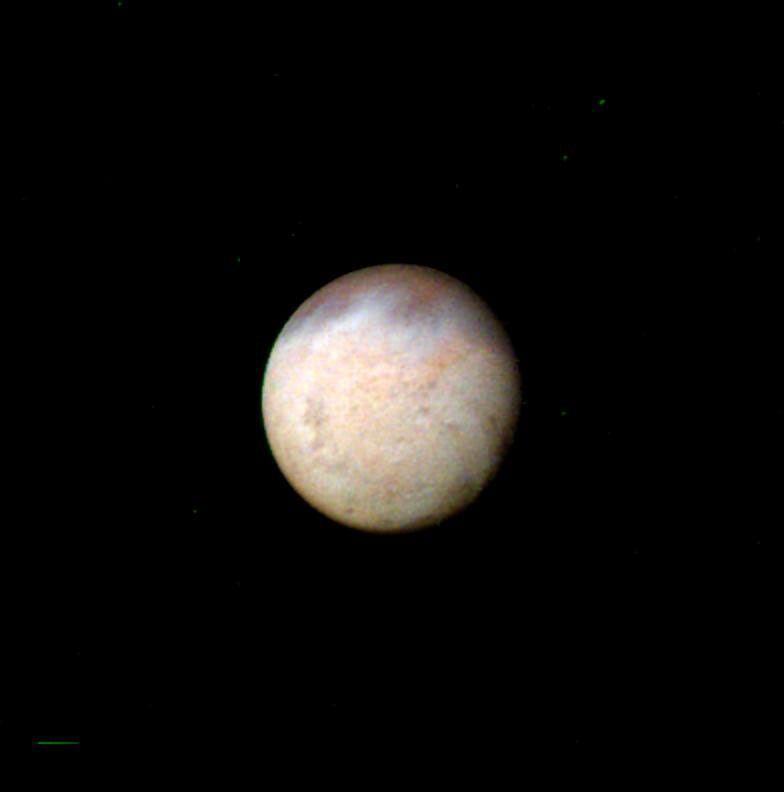
Triton
Neptune's great captured moon — a frigid, geyser-riddled world that almost certainly began its life in the Kuiper Belt before Neptune's gravity claimed it.
Triton
Triton is the largest moon of Neptune and one of the most remarkable objects in the Solar System. With a diameter of about 2,700 km, it is roughly three-quarters the size of Earth's Moon, yet it stands apart from virtually every other large satellite by orbiting its planet in the wrong direction — a retrograde path that takes it around Neptune in the opposite sense to the planet's own rotation. No other large moon in the Solar System is known to behave this way.
That backward orbit is not merely an oddity; it is the clearest sign of Triton's true origin. The overwhelming scientific consensus holds that Triton did not form alongside Neptune but was instead captured from the Kuiper Belt, the vast reservoir of icy bodies beyond Neptune. In size, bulk composition, and volatile inventory, Triton closely resembles Pluto, and the two worlds are thought to have formed in the same cold region of the early Solar System before Triton's fateful encounter with Neptune pulled it into a permanent — and ultimately circular — captive orbit.
Despite surface temperatures hovering around −235 °C, Triton is not a dead world. When Voyager 2 swept past it on 25 August 1989 — the spacecraft's final planetary flyby — it revealed active nitrogen geysers erupting kilometres into the thin atmosphere, young volcanic plains that have wiped out most of the ancient crater record, and a bizarre "cantaloupe terrain" unlike anything seen elsewhere. More than three decades later, Voyager 2 remains the only spacecraft ever to have visited Triton, and the data it returned continue to shape the science of icy worlds throughout the outer Solar System.
Discovery and exploration
- 1844Lassell builds his telescope
English astronomer William Lassell begins constructing the 24-inch reflecting telescope that will later make the discovery of Triton possible.
- 10 Oct 1846Discovery of Triton
Just 17 days after Neptune itself is found, Lassell identifies Triton while searching for satellites of the newly discovered planet. It is the first and, for more than a century, only known moon of Neptune.
- 19th centuryRetrograde orbit confirmed
Continued observations allow astronomers to measure Triton's orbit with good accuracy, revealing that it is retrograde and highly inclined — characteristics recognised as highly unusual for a large moon.
- Until 1949"The satellite of Neptune"
Because it is Neptune's sole known moon for over a century, Triton is simply called "the satellite of Neptune" in most astronomical literature.
- 25 Aug 1989Voyager 2 flyby
Voyager 2 makes its fourth and final planetary flyby, sweeping past Neptune and conducting a close encounter with Triton. The spacecraft reveals active geysers, a thin nitrogen atmosphere, young volcanic terrains, and an extremely cold surface — transforming understanding of icy moons throughout the Solar System.
- 1990sAtmosphere warms
Stellar occultation observations indicate that Triton's atmosphere has warmed and become somewhat denser compared to Voyager-era measurements, suggesting seasonal or longer-term climate variability.
- 2021Trident not selected
NASA selects DAVINCI and VERITAS as its Discovery-class missions, passing over the Trident proposal — a dedicated Triton flyby concept with a proposed launch in 2025–2026. No approved mission to Triton or Neptune currently exists.
- 2024Shared Kuiper Belt origin confirmed
A composition study concludes that Pluto and Triton likely formed in the same region of the outer Solar System, beyond the water-ice line, before Triton was captured by Neptune — reinforcing the Kuiper Belt Object hypothesis.
Physical characteristics
Triton is a substantial world. Its diameter of about 2,700 km places it among the dozen largest moons in the Solar System, and its mean density of approximately 2.06 g/cm³ is considerably higher than the pure-ice densities seen in smaller icy satellites. That elevated density points to a differentiated interior: a core of rock and metal overlaid by a thick mantle of water ice, with the surface itself blanketed by more volatile ices dominated by frozen nitrogen, along with water ice, carbon dioxide ice, and traces of methane and carbon monoxide. Dark deposits of tholins — complex organic compounds produced when nitrogen-methane mixtures are irradiated — add muted reddish hues to parts of the surface, particularly in the southern polar cap.
Triton's surface is extraordinarily reflective, bouncing back roughly 85 to 95 percent of incoming sunlight — far more than Earth's Moon, which reflects only about 11 percent. This high albedo, combined with the great distance from the Sun, keeps Triton's surface temperature at around 38 K (−235 °C), making it one of the coldest measured surfaces in the Solar System. Despite this deep freeze, the surface is geologically young: impact craters are rare across Voyager 2's coverage, meaning internal processes have resurfaced much of the terrain relatively recently in geological terms.
Triton's thin atmosphere is composed primarily of nitrogen, with small amounts of methane. The surface pressure is on the order of 10 to 40 microbars — roughly 1/70,000 of Earth's atmospheric pressure, close to a vacuum. Above the surface, the atmosphere extends to roughly 800 km altitude, where temperatures rise to about 93 K. Thin nitrogen ice clouds and photochemical haze hang approximately 13 km above the surface. Stellar occultation observations made after the Voyager 2 flyby showed that the atmosphere had subsequently warmed and thickened compared to 1989 measurements, hinting at active seasonal cycles driven by Triton's slowly shifting polar geometry.
Retrograde orbit and tidal evolution
Triton's orbit is unique among large moons. It circles Neptune at a mean distance of about 354,800 km with a period of 5.877 days, but it does so in the retrograde direction — opposite to Neptune's rotation — at an inclination of about 157° relative to Neptune's equator. No other large moon in the Solar System orbits in this contrary fashion. Triton is also tidally locked, so the same hemisphere always faces Neptune.
Because retrograde orbits cannot form naturally in a prograde planetary disk, Triton's orbit is itself proof of capture. A moon forming alongside its planet from the same rotating disk of gas and dust would inevitably inherit a prograde orbit. A retrograde orbit can only arise if the object came from outside the system and lost enough energy to become bound. The physics of tidal dissipation then gradually circularised Triton's initially eccentric post-capture orbit, a process that also generated enormous internal heat. Tidal heating during this phase is thought to have driven global differentiation of Triton's interior and may have sustained a liquid water ocean beneath the ice for hundreds of millions to perhaps a billion years after capture.
Triton's retrograde orbit has a continuing consequence: tidal interaction with Neptune is slowly draining orbital energy from Triton rather than adding it. Triton is therefore gradually spiralling inward. In roughly 3.6 billion years, it is expected to pass within Neptune's Roche limit and be torn apart, potentially forming a ring system comparable to Saturn's.
A captured Kuiper Belt object
The hypothesis that Triton is a captured Kuiper Belt Object (KBO) is supported by multiple independent lines of evidence. Triton's diameter of about 2,706 km is only slightly larger than Pluto's roughly 2,376 km, placing it firmly in the dwarf-planet size class typical of the largest KBOs. It is the largest known object believed to have originated in the Kuiper Belt. Compositionally, Triton and Pluto are nearly identical: both have surfaces dominated by nitrogen ice with methane and carbon monoxide, both host nitrogen-dominated atmospheres, and both display dark organic tholins. A 2024 study concluded that the two bodies most likely formed in the same region of the outer Solar System, beyond the water-ice line.
Two principal capture mechanisms have been proposed. The collision model suggests Triton lost orbital energy by striking an existing Neptunian satellite or proto-moon during a close approach. The currently favoured binary capture model proposes that Triton originally belonged to a binary KBO system — analogous to the Pluto-Charon pair. During a close encounter with Neptune, tidal forces disrupted the binary: one body was ejected into interplanetary space while the other, Triton, became gravitationally bound to Neptune. This mechanism is supported by the high observed frequency of binary pairs among large Kuiper Belt Objects and by dynamical simulations showing that such exchange reactions efficiently produce massive, retrograde, captured moons.
Triton's capture also left fingerprints on the rest of Neptune's moon system. Simulations show that a large body arriving on an eccentric, retrograde orbit would have severely disrupted any pre-existing regular moons. This explains both Neptune's comparative lack of large inner moons — unlike Jupiter and Saturn — and the highly eccentric orbit of Nereid, which is thought to be a surviving original Neptunian moon scattered by Triton's arrival. Recent work using JWST spectra and dynamical modelling indicates that Nereid likely formed in situ and was subsequently displaced, adding indirect support to a violent capture scenario.
Voyager 2 and the 1989 flyby
On 25 August 1989, Voyager 2 made its closest approach to Neptune and then turned its instruments on Triton in what would prove to be the spacecraft's fourth and final planetary flyby — the climax of a 12-year journey across the Solar System. Scientists and engineers at JPL later called the Triton plume discovery Voyager's "last hurrah" in its planetary phase. The encounter transformed Triton from a point of light into a detailed, puzzling world.
Voyager 2's cameras and spectrometers revealed a surface of striking variety. A broad pinkish southern polar cap, tinted by radiation-processed methane and nitrogen ices, was overprinted by dark wind streaks deposited by geyser fallout. Beyond the cap lay a bluish crustal region thought to consist mainly of water ice, patterned with interlocking cellular shapes described as resembling "melted chain mail." Crosscutting this zone were vast canyons and long, straight ridges with central furrows, interpreted as material pushed up along crustal fractures — evidence of vigorous tectonic or cryovolcanic activity. Voyager 2's highest-resolution images, covering roughly one-third of Triton's surface, showed a distinctive "cantaloupe terrain" in the equatorial and northern regions: interlocking roughly circular depressions (called cavi) each about 25 to 30 km across, thought to record one or more episodes of near-complete resurfacing, perhaps by cryovolcanism or internal tectonism.
The paucity of impact craters across Voyager 2's coverage confirmed that Triton's surface is geologically young. The largest clearly imaged crater, Mazomba, is only about 27 km in diameter. Jagged mountains, high cliffs, and frozen plains that appeared to be solid water ice behaving like rock at Triton's temperatures completed a portrait of an internally active world far more complex than expected. Spectroscopy identified surface ices of nitrogen, methane, carbon monoxide, carbon dioxide, and water, with nitrogen dominant both on the surface and in the atmosphere.
Key discoveries from the 1989 flyby
Voyager 2 imaged dark, geyser-like plumes erupting from Triton's south polar region, with one plume measured at nearly 8 km high. Dark material — dust and icy particles carried by pressurised nitrogen gas — drifted about 150 km downwind, leaving streaks across the polar cap. Two well-studied plumes, nicknamed Hili and Mahilani, indicated atmospheric winds exceeding 50 km/h. This was the first observation of geyser-style activity on an icy body.
Occultation measurements during the flyby recorded Triton's surface temperature at about 37 K (−236 °C), making it the coldest known surface in the Solar System at that time of measurement.
Voyager 2 confirmed a tenuous nitrogen atmosphere extending to roughly 800 km altitude, with surface pressure only about 1/70,000 of Earth's. Thin nitrogen ice clouds and haze were found at about 13 km altitude.
High-resolution images revealed a bizarre terrain of interlocking circular depressions, each 25–30 km across, criss-crossed by interconnected ridges. This "cantaloupe terrain" is interpreted as the product of extensive cryovolcanic resurfacing, erasing the older cratered surface.
Very few impact craters appear in Voyager 2 coverage, implying extensive and geologically recent resurfacing. The largest imaged crater, Mazomba, is only about 27 km in diameter.
With active plumes confirmed, Triton joined Earth and Jupiter's Io as the third body in the Solar System known to be volcanically or cryovolcanically active at the time of the flyby.
Triton's volatile-rich, nitrogen-dominated composition and KBO-like characteristics established a scientific template that shaped expectations for later missions to Pluto and other distant icy worlds.
Nitrogen geysers and cryovolcanism
The nitrogen geysers of Triton are among the most surprising features of any moon in the Solar System. The leading explanation is solar-driven: Triton's surface nitrogen ice is largely transparent, allowing sunlight to penetrate and warm dark material lying just beneath. As the trapped heat builds, nitrogen gas pressure increases until it vents explosively upward through cracks in the overlying ice, carrying dark dust and icy particles with it. One plume observed by Voyager 2 rose nearly 8 km before the material spread into a cloud that drifted about 150 km downwind, blown by atmospheric winds measured at more than 50 km/h. Some researchers have proposed an alternative cryovolcanic origin for the plumes, in which internal heat rather than sunlight provides the driving energy, though the solar-heating model is more widely accepted.
Beyond the geysers, broader cryovolcanic resurfacing appears to have shaped much of Triton's geology. Smooth volcanic plains, jagged cliffs, and graben-like troughs point to a history in which material — probably water-ammonia mixtures rising from the interior — erupted onto the surface and froze, burying older terrain. This activity is thought to have been powered primarily by the intense tidal heating Triton experienced as its post-capture orbit was circularised. Whether any cryovolcanic activity continues today is unknown; the geysers may be the only currently active expression of Triton's internal energy budget.
Spacecraft visits and proposed missions
Voyager 2
25 Aug 1989Flyby of Neptune and Triton during the spacecraft's fourth and final planetary encounter
Trident (proposed)
Proposed launch 2025–2026; arrival ~2038NASA Discovery-class Triton flyby, studying ocean-world potential, active geology, plumes, and ionosphere
Neptune Odyssey (proposed)
Proposed launch ~2031; arrival ~2043NASA Flagship-class Neptune orbiter with atmospheric probe and multiple Triton flybys
Triton Ocean Worlds Surveyor / TOWS (proposed)
Proposed launch ~2031; arrival ~2047NASA New Frontiers-class Neptune orbiter focused on Triton ocean-world science without atmospheric probe
Triton Hopper (NIAC study)
No defined launch dateRocket-powered hopper lander that would make multiple ballistic hops across Triton's surface using in-situ or carried propellant
Future exploration
As of the mid-2020s, no approved mission to Neptune or Triton exists. The last — and only — close look at Triton remains the 1989 Voyager 2 flyby, meaning that more than three decades of planetary exploration have passed without a follow-up visit to one of the most scientifically compelling worlds in the Solar System.
The closest any proposed mission came to becoming a reality was Trident, a NASA Discovery-class flyby concept that would have launched in October 2025 or 2026, exploiting a favourable 13-year planetary alignment involving a Jupiter gravity assist, and arrived at Triton in 2038. Trident was designed to assess Triton's potential as an ocean world, characterise its active geology and plumes, study its ionosphere, and compare it directly with Kuiper Belt objects. When NASA instead selected DAVINCI and VERITAS for the 2021 Discovery competition, Trident was set aside.
Larger concepts remain on the drawing board. Neptune Odyssey, a proposed Flagship-class orbiter developed for the 2023–2032 Planetary Science and Astrobiology Decadal Survey, would launch around 2031 and arrive at Neptune in approximately 2043 after a Jupiter gravity assist and roughly 12-year cruise. It would carry an atmospheric probe and conduct multiple close Triton flybys. A scaled-down version, the Triton Ocean Worlds Surveyor, targets a similar launch date but arrival around 2047 at New Frontiers cost levels. Neither mission is funded. At the most speculative end, a NIAC-studied "Triton Hopper" concept envisions a rocket-powered vehicle that would land on Triton and make multiple ballistic hops between surface sites, but this remains an early-stage advanced concept with no defined launch date.
Frequently asked questions about Triton
Sources
- Triton — NASA Science
- Triton: Neptune's Moon — NOAA Science On a Sphere
- Triton, Neptune's largest moon — The Planetary Society
- Triton | Facts & Composition — Britannica
- Neptune: Facts — NASA Science
- Triton (moon) — Wikipedia
- 30 Years Ago: Voyager 2's Historic Neptune Flyby — NASA
- Voyager 2 Discovers Eruption on Triton — JPL
- Shrinking Triton: Remembering Voyager 2's Encounter — AmericaSpace
- Triton Hopper: Exploring Neptune's Captured Kuiper Belt Object — NASA NTRS
- The Origins of Nereid, Neptune's Most Eccentric Moon — Caltech
- Exploration of Neptune — Wikipedia
- Proposed NASA Mission Would Visit Neptune's Curious Moon Triton — NASA JPL
- Return to Neptune? Plans to send an orbiter — The Planetary Society
- William Lassell — Britannica
- Triton's Geyser-Like Plumes: Discovery and Basic Characterization (PDF)
- 40 Years of (Triton) Summer — National Air and Space Museum