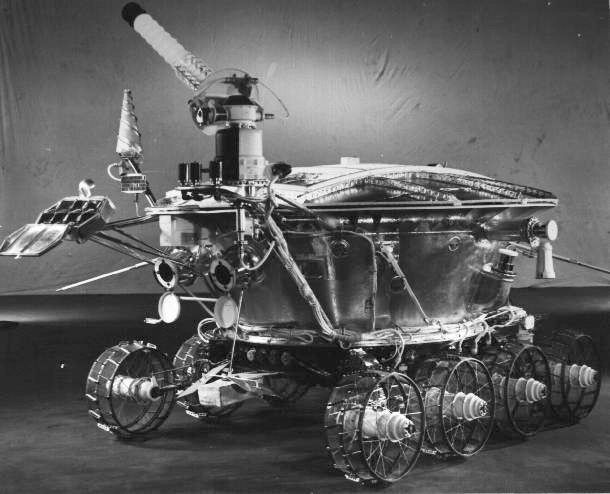
Lunokhod 1
First robotic rover on the Moon — it roamed Mare Imbrium for 322 days, and its retroreflector is still ranged from Earth today.
Lunokhod 1
Lunokhod 1 was the first robotic rover to operate successfully on the surface of the Moon. Carried to the lunar surface by the Soviet Luna 17 lander, it soft-landed in the western Mare Imbrium (Sea of Rains) on 17 November 1970 and immediately drove down the lander's ramps to begin surface operations.
Designed for roughly three lunar days, the rover far outlasted its specification, completing eleven lunar day–night cycles over 322 Earth days before final contact was lost on 14 September 1971. During that period it traversed approximately 10.5 km, returned more than 20,000 television images, performed around 500 soil-mechanics tests, and conducted 25 X-ray fluorescence analyses of the regolith.
Lunokhod 1 also carried a French-built laser retroreflector, a passive device requiring no power. After the rover's precise location was lost following the end of operations, scientists relocated it in March 2010 using imagery from NASA's Lunar Reconnaissance Orbiter, and laser ranging was successfully resumed in April 2010 — finding the reflector in excellent condition and its position determinable to centimetre-level accuracy.
Spacecraft and rover design
The Luna 17 spacecraft soft-landed on the Moon and served as the deployment platform for the rover. It was equipped with dual descent ramps so that Lunokhod 1 could egress from either side, providing redundancy in the event of obstacles near the lander.
Lunokhod 1's body consisted of a tub-like pressurised compartment topped by a large convex hinged lid that bore the solar array panels. The rover measured approximately 2.15 m in length and 1.35 m in height, with a wheelbase of about 1.6 m. It rode on eight independently powered wheels, each with its own drive motor, giving it the ability to continue moving even if individual motors failed.
Two antenna types provided the communications link with Earth: a low-gain cone-shaped omnidirectional antenna for general contact, and a highly directional helical antenna for higher-bandwidth transmissions routed through Soviet deep-space tracking stations.
Four television cameras were mounted on the rover — a front-mounted stereo pair to assist remote driving, plus additional cameras for navigation and panoramic imaging. Combined, they returned more than 20,000 TV images and approximately 200–206 panoramas across the mission.
Power and thermal control
During the lunar day, the hinged lid was tilted to maximise solar-panel exposure, generating approximately 180 W of electrical power that drove the motors and charged onboard rechargeable batteries. When a lunar night began — plunging temperatures to around −150 °C — the lid was closed and the rover entered a hibernation state.
Thermal survival through the roughly 14-Earth-day lunar night was provided by a polonium-210 radioisotope heater unit (RHU), which kept the internal electronics above their minimum operating temperature without requiring any external power source. At the next lunar sunrise, controllers re-established contact and resumed traverses.
Instruments and experiments
- Four-camera television system
Front stereo pair for remote driving; additional cameras for navigation and panoramic imaging. Returned more than 20,000 TV images and ~200–206 panoramas.
- Cone penetrometer / soil-mechanics devices
Extendable devices pressed into or impacted the lunar regolith to measure soil density and mechanical properties. Approximately 500 tests performed.
- X-ray fluorescence spectrometer
In-situ geochemical analysis of regolith elemental composition. Approximately 25 soil analyses completed.
- French-built laser retroreflector array
Passive corner-cube array for lunar laser ranging, enabling precise measurements of Earth–Moon distance and lunar libration. Requires no power.
- X-ray telescope and cosmic-ray detector
Monitored solar X-ray flux and cosmic-ray environment at the lunar surface.
Key events
- 10 Nov 1970Launch
Luna 17 lifts off from Baikonur Cosmodrome Site 81/23 at 14:44:01 UTC on a Proton-K/D rocket.
- 10 Nov 1970Earth parking orbit
Spacecraft inserted into Earth parking orbit at 14:54 UTC.
- 12–14 Nov 1970Mid-course corrections
Two trajectory correction manoeuvres performed on 12 and 14 November.
- 15 Nov 1970Lunar orbit insertion
Luna 17 enters lunar orbit at 22:00 UTC.
- 17 Nov 1970Lunar landing
Luna 17 soft-lands in western Mare Imbrium at 03:47 UTC at 38.2378°N, 35.0017°W.
- 17 Nov 1970Rover deployment
Lunokhod 1 drives down the lander's ramp and reaches the lunar surface at 06:28 UTC.
- Nov 1970 – Sep 1971Surface operations
Rover completes eleven lunar day–night cycles, traversing ~10.5 km and returning over 20,000 TV images.
- 14 Sep 1971Last contact
Final communications session ends at 13:05 UTC. Subsequent contact attempts following the lunar night fail.
- 4 Oct 1971Mission formally ended
Soviet authorities formally conclude the Lunokhod 1 mission after unsuccessful attempts to re-establish contact.
- 17 Mar 2010Rediscovered by LRO
Albert Abdrakhimov identifies both the Luna 17 lander and Lunokhod 1 rover in LRO Narrow Angle Camera image M114185541RC.
- 22 Apr 2010Laser ranging resumed
The APOLLO team at Apache Point Observatory directs laser pulses at the new LRO-derived coordinates and immediately detects a strong return, confirming the retroreflector's location and excellent condition.
- Nov 2010Position refined to centimetre accuracy
Multiple ranging sessions at different lunar librations allow APOLLO to constrain the retroreflector's selenographic coordinates to within about one centimetre.
Key findings
About 500 penetrometer and soil-mechanics tests across Mare Imbrium provided detailed data on lunar regolith density, bearing strength, and mechanical properties over a traverse of 10.5 km — far more spatial coverage than any static lander could achieve.
Twenty-five X-ray fluorescence analyses documented the geochemical character of the western Mare Imbrium surface, contributing to the understanding of basaltic mare composition.
More than 20,000 television images and approximately 200–206 panoramas provided the first extensive visual survey of a mare landing site, revealing surface texture, rock abundance, and small-scale morphology.
The French-built retroreflector array allowed ground-based observatories to bounce laser pulses off the Moon, contributing to measurements of Earth–Moon distance and lunar libration. Because of Lunokhod 1's position near the lunar limb, it provides especially strong geometric leverage for libration studies.
After nearly 40 years of silence, LRO imagery and APOLLO laser ranging confirmed the retroreflector was intact and returning a signal approximately four times stronger than Lunokhod 2's reflector. Its position was refined from kilometre-level uncertainty to centimetre-level precision.
Rediscovery in 2010
When Lunokhod 1 fell silent in September 1971, its precise final location was not well constrained, and subsequent attempts to obtain a laser return from its retroreflector were unsuccessful. The rover's position remained uncertain at the kilometre scale for nearly four decades.
On 17 March 2010, Albert Abdrakhimov identified both the Luna 17 lander and the Lunokhod 1 rover in a Lunar Reconnaissance Orbiter Narrow Angle Camera image (M114185541RC). The LRO Camera team, led by Mark Robinson at Arizona State University, derived coordinates accurate to roughly 100 m by combining the high-resolution imagery with altimetry from the Lunar Orbiter Laser Altimeter.
Using those coordinates, the Apache Point Observatory Lunar Laser-ranging Operation (APOLLO) team, led by Tom Murphy of UC San Diego, aimed the observatory's 3.5 m telescope at the site on 22 April 2010. A strong return signal was detected immediately, confirming the rover's location. The initial measurement placed the reflector approximately 40 m offset in range — about 100 m laterally — from the LRO-based estimate, at the edge of APOLLO's timing gate.
By combining ranging measurements taken at different lunar librations, the APOLLO team intersected the resulting distance spheres to triangulate the reflector's position. By November 2010 the coordinates were known to within about one centimetre. The retroreflector was found to be in excellent condition, returning a signal roughly four times stronger than that from Lunokhod 2's reflector. The results were published in the 2011 paper "Laser ranging to the lost Lunokhod 1 reflector" in Icarus. Because the site lies near the lunar limb as seen from Earth, Lunokhod 1's reflector is particularly valuable for constraining lunar libration and the orientation of the Moon.
About Lunokhod 1
Related
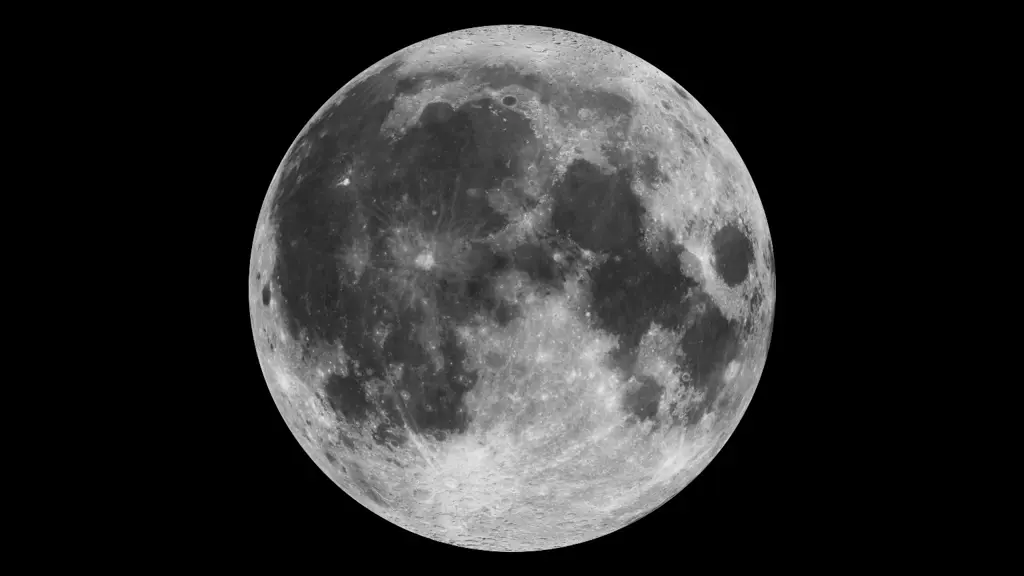
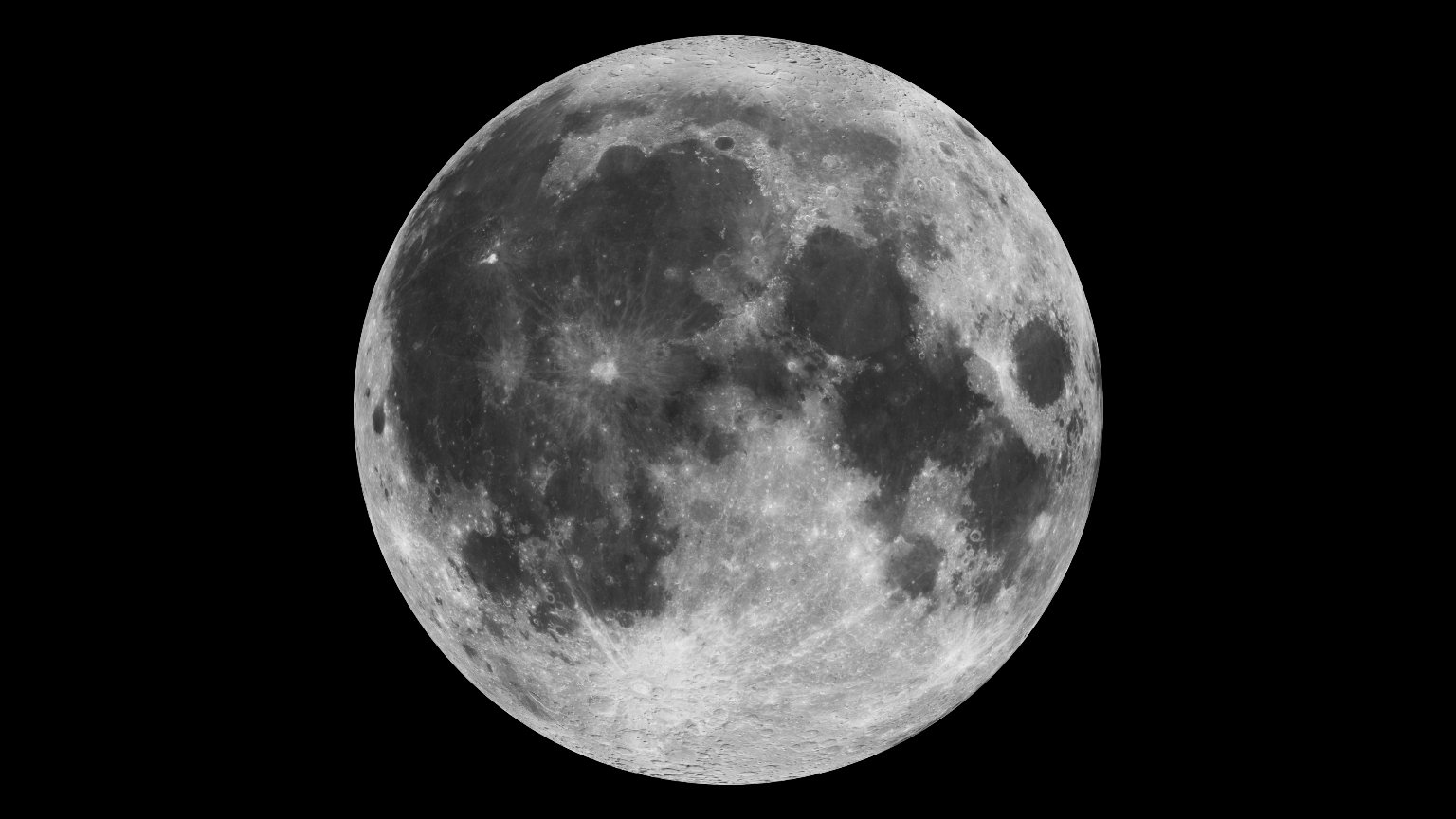
The Moon
Earth's only natural satellite — a world of craters, ancient volcanoes, and frozen water that shapes our tides, steadies our seasons, and beckons a new generation of explorers.
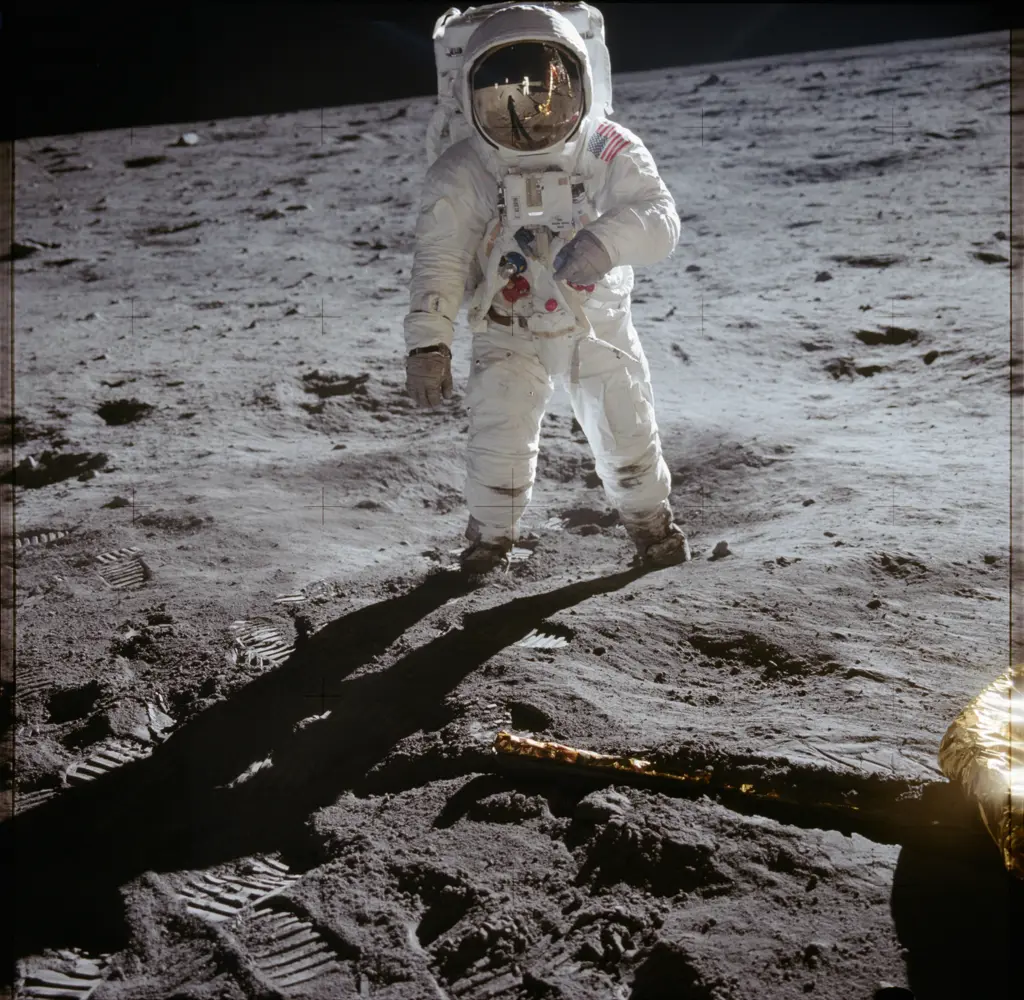
Apollo Program
RetiredLanding humans on the Moon, 1969–1972
Artemis Program
OperationalReturning humans to the Moon — to stay
Perseverance Rover
OperationalHunting for ancient life in Jezero Crater
Sources
- Lunokhod 1: 1st Successful Lunar Rover – Space.com
- Lunokhod 1 – Wikipedia
- This Month in Astronomical History: November 2022 – AAS
- The Soviet Lunokhod 1 rover went silent on the Moon in 1971 – SpaceDaily
- Lunokhod: Moon Robot – National Air and Space Museum
- Laser Ranging to the Lost Lunokhod 1 Reflector – arXiv
- Laser ranging to the lost Lunokhod 1 reflector – ScienceDirect (Icarus)
- Luna 17 – Wikipedia
- Soviet Union Lunar Rovers – LROC
- Lunokhod 1 Revisited – LROC