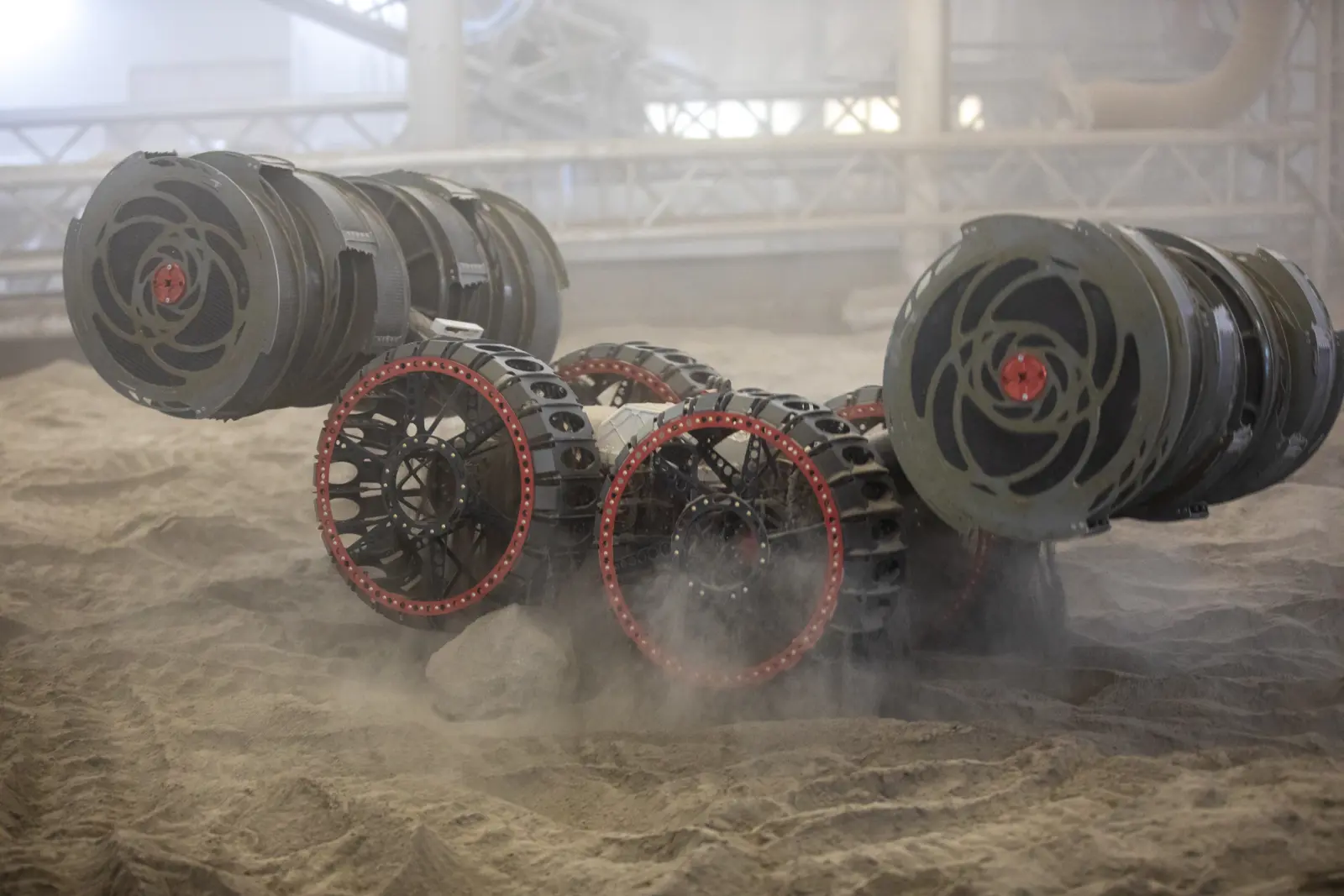
ISRU plant
Surface processing systems that mine oxygen, water, and construction materials from planetary regolith — reducing dependence on Earth resupply for long-duration human exploration.
ISRU Plant
An in-situ resource utilization (ISRU) plant is a surface processing system designed to collect, process, store, and supply local materials found at a planetary destination — such as the Moon or Mars — rather than transporting consumables from Earth. The principal products are oxygen for life support and propulsion, water for crew use and electrolysis, and hydrogen for fuel and chemical reduction. Metals and construction materials extracted as by-products can support in-place manufacturing and infrastructure.
NASA identifies oxygen, water, and methane as especially promising ISRU commodities for reducing mass and cost in human exploration architectures. By generating these resources locally, ISRU plants can dramatically lower launch mass requirements and enable long-duration lunar and Martian operations that would otherwise be logistically prohibitive.
As of 2024, no production-scale ISRU plant has been flight-qualified or operated on another world. Most integrated systems remain at technology readiness levels (TRL) 4–6, though selected subsystems — notably the MOXIE oxygen-generation unit aboard NASA's Perseverance rover — have reached TRL 7–8 through in-space operation.
Mission role and resource products
An ISRU plant encompasses the full chain of operations from excavation through beneficiation, processing, storage, and product delivery. For a lunar or Martian base, the core outputs fall into three categories. First, oxygen: used as breathing gas in habitats and extravehicular activity suits, as an oxidizer for rocket engines, and as feedstock for fuel cells. Second, water: for drinking, hygiene, agriculture, and as the primary feedstock for electrolysis to produce O₂ and H₂. Third, structural metals and construction materials: iron, titanium, aluminum, and other elements freed from reduced regolith, with potential use in additive manufacturing and habitat construction.
These outputs enable closed-loop or partially closed-loop surface mission architectures. Early human outposts on the Moon or Mars would still receive some supplies from Earth, but a functioning ISRU plant reduces that dependence progressively — with the long-term goal of providing virtually all propellant and life-support consumables from local sources.
Water extraction from regolith
Water on the Moon is concentrated in permanently shadowed regions (PSRs) at the poles, mainly as icy regolith at very low temperatures below 110 K. It also exists as chemically bound water or hydroxyl in minerals and glasses, and as adsorbed volatiles — water, ammonia, methane, and others — in cold traps. On Mars, water is found in subsurface ice and hydrated regolith.
Extraction typically proceeds in four steps. Robotic or human-tended excavators collect icy or hydrated regolith and deliver it to a processing reactor. The regolith is then heated — by solar thermal, resistive, or microwave means — to release water vapor and other volatiles; this approach is often called thermal mining. Released vapors are captured, cooled, and condensed into liquid water, which is then purified for potable use or electrolysis. Finally, electrolysis splits water into O₂ and H₂: oxygen is stored as gas or cryogenic liquid, while hydrogen is used as fuel or recycled to regolith-reduction reactors.
Several specialized hardware concepts have been studied. A solar-thermal mining approach redirects sunlight collected at crater rims via mirrors into PSRs to sublimate ices; vapor is collected inside a tent structure and condensed in cold traps. Hollow auger drill systems excavate icy regolith and deliver it to a dryer where heating releases water — the Lunar Auger Dryer ISRU (LADI) concept follows this approach. Laboratory work has also demonstrated microwave heating of lunar regolith simulant containing ice, validating a non-contact heating method suited to deep or cold environments.
An additional volatile source is the residual propellant remaining in descent stages after lunar landing. Proposed ISRU systems would convert leftover propellants into water, then combine in-situ oxygen with excess hydrogen to produce additional water — increasing overall resource recovery efficiency at early bases.
Oxygen extraction from lunar regolith
Lunar regolith is rich in oxygen chemically bound in silicates and oxides — for example, FeO in iron-bearing minerals. Three main electrochemical and thermochemical routes have been studied for extracting this oxygen.
Hydrogen reduction reacts iron oxides in regolith with H₂ gas at approximately 900–1,000 °C, producing iron metal and water vapor. The water is condensed, then electrolyzed to recover O₂ and regenerate H₂ for recycling. This closed loop also yields metallic iron as a by-product potentially useful for construction. ESA's PROSPECT payload team demonstrated hydrogen reduction on Apollo 11 and Apollo 16 soil samples (10084 and 60500), achieving measurable water production. NASA's RESOLVE/RPM payload (developed with the Canadian Space Agency) incorporates a hydrogen reduction demonstration in which regolith is heated from roughly 150 °C to 900 °C while H₂ flows through to extract oxygen as water, which is then captured and quantified. ESA conceptual designs project large-scale production on the order of 1,000 kg of O₂ per year.
Carbothermal reduction reacts regolith with methane or other carbon-bearing gases at high temperature to free oxygen from silicates and oxides. Downstream processing separates CO and CO₂ products and converts them to O₂ — for example via solid-oxide electrolysis — while carbon-bearing gases are recycled. NASA's ISRU Pilot Plant concept employs this approach. Hybrid architectures have been proposed that combine carbothermal reduction of dry regolith at peaks of eternal light with water extraction from icy regolith in nearby PSRs, either in parallel or series configurations.
Molten regolith electrolysis (MRE) directly melts regolith and applies electric current; metals are reduced at the cathode and oxygen evolves at the anode. It requires no additives and is considered the most direct method to produce both oxygen and metals on the Moon, though it demands very high operating temperatures and robust materials. Molten salt electrolysis (MSE) dissolves or suspends regolith in a molten salt, potentially achieving comparable outputs at somewhat lower temperatures. Both electrochemical approaches simultaneously yield oxygen and metallic elements useful for construction.
Key experiments and systems
- Mars Oxygen In-Situ Resource Utilization Experiment
Solid-oxide electrolysis unit aboard NASA's Perseverance rover; demonstrated oxygen production from Martian CO₂ across 16 runs totalling 122 g of O₂ at peak output of 12 g/hr.
- Package for Resource Observation and in Situ Prospecting for Exploration, Commercial Exploitation and Transportation
ESA payload concept incorporating a prototype hydrogen reduction reactor; tested on Apollo soil samples to demonstrate water production via FeO reduction.
- Regolith & Environmental Science and Oxygen & Lunar Volatile Extraction / Resource Prospector Mission
NASA–Canadian Space Agency payload designed to prospect polar volatiles and demonstrate hydrogen reduction oxygen extraction from regolith.
- Polar Resources Ice Mining Experiment
CLPS-delivered experiment to drill and analyze ice-bearing regolith in a lunar polar region; part of NASA's polar resource demonstration sequence.
- Lunar Auger Dryer ISRU
Conceptual water processing plant using a hollow auger to excavate icy PSR regolith, followed by heating to vaporize and collect water for life support and propellant.
- Moon-to-Mars Planetary Autonomous Construction Technology
NASA project to develop autonomous regolith-based construction capabilities, including landing pads requiring several thousand kilograms of lunar regolith.
- ICON Project Olympus
NASA-supported large-scale 3D printing platform designed to produce landing pads, roads, and pressurized habitats from native lunar or Martian regolith using laser vitrification.
Mars ISRU: MOXIE and atmospheric oxygen
The Mars Oxygen In-Situ Resource Utilization Experiment (MOXIE), carried aboard NASA's Perseverance rover as part of the Mars 2020 mission, is the most concrete in-space ISRU demonstration conducted to date. MOXIE uses solid-oxide electrolysis to convert carbon dioxide from the Martian atmosphere — which is approximately 95% CO₂ — into oxygen. Its design requirements were to produce at least 6 g/hr of oxygen at 98% purity or better, and to complete at least 10 operating cycles on Mars meeting those targets.
Between landing in February 2021 and the conclusion of its mission on 30 September 2024, MOXIE completed 16 oxygen-production runs. Total oxygen produced across all runs was 122 g. Peak performance reached 12 g/hr at 98% purity or better — twice NASA's original goal. MOXIE's 16th and final run produced 9.8 g of oxygen. The instrument satisfied all success criteria and experienced no failures.
A detailed post-mission summary noted that MOXIE's design translated from Earth laboratory to Mars with no degradation in performance. The instrument demonstrated robustness against thermal cycling, Martian dust, and seasonal changes in atmospheric density and temperature. Dust was determined to be of little concern for a full-scale ISRU oxygen plant — an important design insight for future systems. Impurity levels in the produced oxygen were described as unmeasurably low, far exceeding the 98% purity requirement.
MOXIE is explicitly a technology demonstrator, not a plant: it has no integrated fuel synthesis, liquefaction, storage, or large-scale production capacity. Future Mars ISRU plants would combine atmospheric CO₂ processing with water extraction from subsurface ice or hydrated regolith, and would synthesize methane and oxygen as ascent vehicle propellant in addition to providing breathable air for crews. The MOXIE results provide benchmarks — production rates, purity figures, and operational lessons — for scaling to larger systems.
Regolith-based 3D printing and construction
ISRU plants are not limited to chemical processing; they also encompass additive manufacturing and construction from local regolith, reducing or eliminating the need to launch structural materials from Earth. As of 2024, no true regolith-based habitat has been constructed on the Moon or Mars — all demonstrated elements are Earth-based analogs or small-scale laboratory components.
NASA has supported Texas-based construction company ICON to develop a large-scale 3D printing platform called Olympus, designed to print landing pads, roads, and eventually pressurized habitats using native lunar or Martian soil. Olympus employs a laser-based process called Laser Vitreous Multi-material Transformation, in which a high-powered laser melts regolith, which then cools into a ceramic-like solid. In February 2025, ICON flew the Duneflow experiment on a Blue Origin reusable rocket under NASA's Flight Opportunities program to test how simulant behaves in lunar gravity and to advance the laser-based processing system. Separately, NASA's MMPACT project targets autonomous construction capabilities for lunar bases, with early projections indicating that a 30-metre-diameter lunar landing pad would require several thousand kilograms of lunar regolith.
ESA and architecture firm Foster + Partners have produced structural elements from lunar regolith simulant, including a 1,500 kg building block. Their favored hybrid approach places a conventional habitat module on the surface and surrounds it with a 3D-printed layer of compacted or sintered regolith for radiation and micrometeoroid protection. The EU Horizon 2020 RegoLight project demonstrated solar-driven sintering — fabricating bricks layer-by-layer using concentrated sunlight, without imported binders. The German MOONRISE project mounted a customized laser on a prototype lunar rover to melt regolith into spherical shapes, pointing toward mobile robotic systems capable of driving across the surface and sintering structural features in place.
The Redwire Regolith Print study aimed to demonstrate in-space manufacturing on the International Space Station using a fused-deposition-like process with feedstock of metal oxides and binder derived from lunar regolith simulant, with printed test plates returned to Earth for materials analysis. A 2024 review of in-situ additive manufacturing with lunar regolith concluded that regolith-based geopolymers and sintered structures are promising but face challenges in binder availability, achieving adequate mechanical properties, and scaling to habitat-level structures in the lunar environment.
Technology readiness status (2024)
Technology readiness levels (TRL) run from 1 (basic concept) to 9 (mission-proven). TRL 6 denotes a system or subsystem prototype demonstrated in a relevant environment; TRL 8 requires the actual system completed and qualified in its final form under expected conditions; TRL 9 means the system has proven through successful mission operations.
As of 2024, integrated ISRU plants for lunar or Martian resource extraction and processing are generally at TRL 4–6. Bench-scale reactors for processes such as molten regolith electrolysis, carbothermal reduction, and hydrogen reduction have been demonstrated with lunar regolith simulants in laboratory vacuum and thermal conditions, corresponding to TRL 4–5. Prototype testbeds that integrate regolith feed systems, reactors, and basic product handling in ground facilities using simulant and vacuum chambers reach TRL 5–6. No complete end-to-end plant — covering excavation, beneficiation, processing, storage, and distribution — has been operated on the Moon, and none has been flight-qualified to TRL 8.
Selected subsystems stand at higher readiness. Resource-characterization instruments such as spectrometers, radars, and cameras that have flown on lunar missions can reach TRL 8–9 individually. For Mars, the MOXIE solid-oxide electrolysis unit achieved TRL 7–8 by operating successfully in the actual Martian environment. However, MOXIE is a single processing subsystem; a complete Mars ISRU plant integrating Sabatier reactors, electrolysis, liquefaction, and large-scale storage remains at approximately TRL 3–5 as an integrated system, since no full chain has flown and operated on Mars.
ISRU history
- 1903Tsiolkovsky proposes space resource use
Konstantin Tsiolkovsky suggested using extraterrestrial materials and space-based energy for exploration, originating modern concepts of space resource utilization.
- 1950sClarke proposes lunar propellant production
Arthur C. Clarke proposed using lunar resources to create rocket propellants, arguing this would facilitate broader space exploration.
- 1969–1972Apollo program returns 382 kg of lunar samples
Six crewed Apollo missions returned 382 kg of lunar material. These samples became the primary scientific foundation for ISRU research, enabling bench-scale oxygen extraction and regolith processing experiments for decades.
- 2004NASA ISRU Capability Roadmap published
NASA's Advanced Planning and Integration Office produced an ISRU roadmap and timeline extending to approximately 2040, assuming progressive lunar landing and ISRU capability milestones.
- Late 2000sTerrestrial ISRU field tests
NASA and partners including the Pacific International Space Center for Exploration Systems (PISCES) and the Canadian Space Agency conducted field tests of lunar ISRU techniques — regolith excavation, volatile extraction — at analog sites in volcanic and desert environments.
- Apr 20, 2021MOXIE first oxygen production run on Mars
MOXIE aboard Perseverance produced oxygen from the Martian atmosphere for the first time, yielding 5.37 g in its inaugural run — enough for approximately 10 minutes of breathable air for an astronaut.
- Sep 30, 2024MOXIE mission concluded
After 16 runs totalling 122 g of O₂ and a peak output of 12 g/hr, MOXIE concluded its mission having satisfied all success criteria and experiencing no failures.
- Feb 2025ICON Duneflow experiment flown
ICON flew the Duneflow experiment on a Blue Origin reusable rocket under NASA's Flight Opportunities program, testing regolith simulant behavior in lunar gravity to advance laser-based in-situ construction technology.
What ISRU research has established
MOXIE demonstrated that CO₂ from the Martian atmosphere can be reliably converted to oxygen via solid-oxide electrolysis in the actual Martian environment — across day and night, all seasons, and varying atmospheric pressures — with no unexpected performance degradation and purity exceeding 98%.
Post-mission analysis of MOXIE determined that Martian dust is of little concern for a full-scale ISRU oxygen plant, an important design insight that reduces risk estimates for future systems.
ESA's PROSPECT team demonstrated hydrogen reduction on actual Apollo 11 and Apollo 16 soil samples, achieving measurable water production and confirming that FeO-bearing lunar regolith can be processed to yield oxygen via this route.
Reviews of lunar oxygen production processes — hydrogen reduction, carbothermal reduction, molten regolith electrolysis, and molten salt electrolysis — confirm that all are technically feasible at laboratory scale, with trade-offs in temperature requirements, additive needs, and simultaneous production of metallic by-products.
Projects including ESA/Foster + Partners (1,500 kg simulant building block), RegoLight (solar-driven sintering), and MOONRISE (on-rover laser melting) have demonstrated that regolith can be converted into coherent solid structures on Earth, with laser and solar-based methods requiring no imported binders.
As of 2024, all integrated ISRU plants remain at TRL 4–6. No end-to-end system covering excavation, processing, storage, and distribution has been operated on the Moon or qualified for flight, leaving a significant gap between current subsystem maturity and mission-ready production plants.
Frequently asked questions
Related
Perseverance Rover
OperationalHunting for ancient life in Jezero Crater
Artemis Program
OperationalReturning humans to the Moon — to stay


Apollo Program
RetiredLanding humans on the Moon, 1969–1972
The Moon
Earth's only natural satellite — a world of craters, ancient volcanoes, and frozen water that shapes our tides, steadies our seasons, and beckons a new generation of explorers.

Mars
The fourth planet from the Sun — a cold, rocky desert world with the Solar System's tallest volcano, two tiny moons, and abundant evidence of an ancient watery past.
Sources
- Lunar In-Situ Resource Utilization — IAC-10 paper (Global Space Exploration)
- Overview: In-Situ Resource Utilization — NASA
- In-Situ Resource Utilization (ISRU) — Envisioning.io Substrate
- Overview of Lunar In Situ Resource Utilization Techniques — Space: Science & Technology (SPJ)
- In Situ Resource Utilization: The Future of Human Settlements in Space — Space Resource Technologies
- In-Situ Resource Utilization (ISRU) — Meegle
- In situ resource utilization — Wikipedia
- Review of techniques for In-Situ oxygen extraction on the Moon — Planetary and Space Science (ScienceDirect)
- Lunar Surface Innovation Consortium: In Situ Resource Utilization
- Mars Oxygen ISRU Experiment (MOXIE) — PDS Atmospheres Node
- Mars Oxygen ISRU Experiment (MOXIE) — Preparing for human Mars exploration (Science Advances)
- MIT's MOXIE experiment reliably produces oxygen on Mars — MIT News
- NASA's Oxygen-Generating Experiment MOXIE Completes Mars Mission — NASA
- Summary report on the Mars Oxygen ISRU Experiment (MOXIE) — LPSC 2024 (USRA)
- 18 Months of MOXIE operations on Mars — Acta Astronautica (ScienceDirect)
- Modeling Lunar ISRU Extraction Can Help Plan Future Prototypes — Universe Today
- Water extraction and collection from icy lunar regolith by microwave heating — Acta Astronautica (ScienceDirect)
- Future Missions & In Situ Resource Utilization (ISRU) Requirements — NASA/Caltech KISS presentation
- Lunar ISRU Presentation to LSIC — NASA LSIC
- NASA In Situ Resource Utilization (ISRU) Moon to Mars — Explore Mars presentation
- Water Extraction from Regolith (ISRU) — NASA TechPort
- Lunar Water Extraction via Lunar Auger Dryer ISRU (LADI) — AIAA ASCEND 2023
- Design architecture for 3D printing a lunar habitat — Room: The Space Journal
- ICON and NASA Continue Collaboration to Move Lunar Construction Forward — 3DPrint.com
- How to Make Building Blocks for a Lunar Habitat — Universe Today
- In-situ additive manufacturing with lunar regolith for lunar base construction (2024 review) — Additive Manufacturing Letters (ScienceDirect)
- Relevant Environment Additive Construction — NASA TechPort
- In-Situ Resource Utilization (ISRU) — NASA Mission page
- Toward the utilisation of resources in space: knowledge gaps, open questions — npj Microgravity (Nature)
- Past, present and future rationale for space resource utilisation — Planetary and Space Science (ScienceDirect)