LunaNet relay
NASA's open lunar internet — an interoperable communications, navigation, and timing network for the Moon.
LunaNet
LunaNet is NASA's open, interoperable lunar communications, navigation, and timing architecture — a framework of cooperating networks designed to provide internet-like connectivity for missions in transit to, in orbit around, and on the surface of the Moon. Rather than a single system owned by one agency, LunaNet is conceived as a "network of networks" that allows multiple providers — government agencies, commercial operators, and international partners — to supply compatible services to common users across cislunar space.
NASA's concrete implementation of LunaNet is the Lunar Communications Relay and Navigation System (LCRNS), managed by the Exploration and Space Communications (ESC) program at Goddard Space Flight Center. The technical foundation is the LunaNet Interoperability Specification (LNIS), developed collaboratively by NASA, ESA, and JAXA, with version 5 published in February 2025 as the current baseline.
LunaNet is a core infrastructure element of the Artemis program, designed to support Orion, the Human Landing System, surface rovers, extravehicular activities, and Commercial Lunar Payload Services (CLPS) payloads, as well as future international and commercial lunar missions.
Architecture and services
LunaNet is structured as a service-oriented architecture in which distributed nodes — located at Earth ground stations, in lunar orbit, and on the lunar surface — cooperate to deliver four main categories of service: networking, navigation, detection and information, and radio and optical science. Earlier formulations grouped these as networking, position/navigation/timing (PNT), and science utilization, but the current NASA framing expands the taxonomy to four categories.
The communications framework is built on Delay/Disruption Tolerant Networking (DTN), which allows data to be stored and forwarded when links are intermittent. This removes the need for pre-scheduled Earth contact windows and enables more autonomous surface and orbital operations. The architecture is explicitly designed to be extensible and scalable, allowing additional nodes from new providers to join the network as the lunar economy grows.
For navigation, LunaNet provides the measurements needed for onboard orbit determination, guidance, and surface positioning, aiming to give lunar assets Earth-independent PNT capability. The architecture supports both broadcast and point-to-point navigation services, analogous to terrestrial GNSS but adapted for the cislunar environment. All providers must reference a common Lunar Reference System (LRS) and Lunar Time System, defined in the LNIS Applicable Document AD-5, so that position and time data from different providers can be combined seamlessly.
LunaNet Interoperability Specification (LNIS)
The LunaNet Interoperability Specification (LNIS) is the primary standards document that defines how LunaNet-compliant systems must interface. It specifies agreed protocols, frequency bands, signal structures, and reference systems so that different LunaNet Service Providers (LNSPs) can serve common users. LNIS is developed through tri-lateral working groups among NASA, ESA, and JAXA, with input from the Consultative Committee for Space Data Systems (CCSDS) and the Interagency Operations Advisory Group (IOAG).
Version 4 of LNIS was published on 12 September 2022 and served as the basis for early procurements by all three founding partners. Version 5, published online on 7 February 2025 following approval at a joint Directorate Program Management Council on 29 January 2025, is considerably expanded and altered relative to v4. LNIS v5 specifies that interoperable link-layer services initially require CCSDS AOS frames or fixed-length USLP frames. The LunaNet Signal-In-Space (LSIS) v1, which defines the Augmented Forward Signal (AFS) used for navigation, was made available alongside LNIS v5 as a draft for public comment.
LNIS is accompanied by a suite of Applicable Documents covering specific technical areas: AD-1 (LSIS, Augmented Forward Signal and message structure), AD-2 (measurement schema and parameters), AD-3 (detailed message definitions), AD-4 (location services for users), AD-5 (Lunar Reference System and Lunar Time System), and AD-7 (LunaSAR search-and-rescue service definitions). Together these documents form the complete standards architecture for LunaNet communications and navigation interoperability.
For a provider to qualify as a LunaNet Service Provider for the Lunar Augmented Navigation Service (LANS), LNIS requires adoption of the common AFS signal and message structure, meeting signal-in-space error requirements, and meeting power-at-surface requirements so users on or near the lunar surface receive adequate signal strength. This approach allows navigation signals from different providers to be combined in a multi-constellation fashion analogous to GPS and Galileo on Earth.
Coverage and relay orbits
NASA's Lunar Relay Services Requirements Document (SRD) defines three service volumes for relay coverage. Service Volume III (SV3) encompasses the entire lunar surface at all latitudes and extends to altitudes of at least 200 km, corresponding to global lunar surface coverage for communications and PNT. Within SV3, relay services are required to provide Ka-band return data services, S-band forward and return data services, and point-to-point PNT link services at specified coverage percentages.
LunaNet does not mandate a specific relay orbit; the SRD states that LCRNS orbits are defined by the service provider. Relay constellations must meet the interoperability and service-volume performance requirements of the SRD and LNIS, but providers are free to select orbits — such as near-rectilinear halo orbits (NRHO), elliptical lunar frozen orbits (ELFOs), or polar orbits — that satisfy coverage requirements. The navigation side of LunaNet has a published baseline of eight navigation satellites in two stable ELFOs.
For early Artemis-era operations, relay and PNT services are expected to concentrate on the South Pole region. ESA's Moonlight initial service concept targets a minimum of approximately 15 hours of continuous PNT service at the South Pole every 24 hours, with position accuracy goals of roughly 100 m for orbiters, 50 m for landing, and 10 m for surface operations (3 m with post-processing). The long-term architecture targets full global lunar surface coverage, with the mature LunaNet network sized to ensure any point on the lunar surface lies within the service volume of at least several relay satellites.
Surface users connect to orbital relays via S-band and Ka-band proximity links, with optical links also under consideration. Local surface-to-surface connectivity is envisaged using Wi-Fi (2.4/5 GHz) and 3GPP LTE/5G (Release 16 and later) networks, backhauled through orbital relay nodes.
LunaNet milestones
- Sep 12, 2022LNIS v4 published
NASA publishes LunaNet Interoperability Specification version 4, the first widely available baseline for LunaNet compliance.
- Dec 5, 2022LCRNS Services Requirements Document baselined
NASA publishes the Lunar Relay Services Requirements Document (SRD) for LCRNS, defining relay and navigation requirements for LunaNet Service Providers supporting Artemis. The SRD sets an IOC build-out period of 2025–2028 and an EOC target of around 2030.
- Late 2023LNIS v5 draft released
A draft of LNIS version 5 is circulated for review among NASA, ESA, JAXA, CCSDS, and IOAG stakeholders.
- 2024Intuitive Machines selected as first commercial LCRNS provider
NASA's Exploration and Space Communications program selects Intuitive Machines under the Near Space Network Services contract as the first commercial provider of LCRNS relay and navigation services in lunar orbit.
- Apr 2024ispace-U.S. announces Mission 3 relay satellites
ispace Technologies U.S. announces a data relay service enabled by two relay satellites to be deployed in lunar orbit during Mission 3, scheduled for 2026 and expected to launch on a SpaceX vehicle.
- May 7, 2024Lunar Interoperability Forum
CCSDS and IOAG co-host a Lunar Interoperability Forum in Washington, DC, to accelerate international lunar communications and PNT standards across NASA, ESA, and JAXA.
- Oct 15, 2024ESA LCNS prime contract signed
Telespazio signs the LCNS prime contract with ESA to manage development of the Moonlight satellite constellation, with consortium partners including Hispasat, Inmarsat, Thales Alenia Space Italia, Qascom, MDA UK, and others.
- Nov 2024ESA LCNS programme officially commenced
ESA officially commences the LCNS programme at the International Astronautical Congress in Milan, signing a €123 million contract with Telespazio for LCNS development.
- Jan 29, 2025LNIS v5 approved
NASA, ESA, and JAXA approve LNIS v5 at a joint Directorate Program Management Council meeting.
- Feb 7, 2025LNIS v5 published
LunaNet Interoperability Specification version 5 is published online as the current LNIS baseline, considerably expanded relative to v4 and adopted by NASA LCRNS, ESA Moonlight, and Japan LNSS.
- Mar 2025Thales Alenia Space contracted to build LCNS satellites
Telespazio awards Thales Alenia Space a contract to build four LCNS satellites and develop elements of the ground segment for ESA's Moonlight constellation.
- Jul 2025SSTL and MDA Space UK join Moonlight
Surrey Satellite Technology Ltd and MDA Space UK join the Moonlight programme to work with Viasat, which ESA selected to lead the lunar orbiting satellite communications portion of LCNS.
- Sep 2025Telespazio and ispace letter of intent
Telespazio and ispace sign a letter of intent to collaborate on LCNS, potentially using ispace's lunar transfer technology to deliver LCNS satellites into lunar orbit.
- Nov 2025ESA member states confirm Moonlight funding
ESA member states confirm €176 million in Moonlight funding for the following three years.
- 2026 (planned)NASA LCRNS relay operations begin
NASA LCRNS operational lunar relay deployment targeted to begin (~2026) with Intuitive Machines providing LunaNet-compatible relay services. Intuitive Machines' third mission is also planned to deploy the first of five commercial lunar data relay satellites, initiating a pay-by-the-minute relay service. ispace-U.S. Mission 3 aims to deploy two relay satellites into lunar orbit via the APEX 1.0 lander.
- 2028 (planned)Full NASA LCRNS IOC; ESA Moonlight and Japan LNSS demonstrations
NASA LCRNS reaches full Initial Operating Capability. ESA Moonlight LCNS and Japan's Lunar Navigation Satellite System (LNSS) both target operational capability around 2028, with a first international LANS PNT interoperability demonstration planned jointly by NASA, ESA, and JAXA.
- ~2030 (planned)Enhanced Operating Capability (EOC)
LunaNet EOC begins, with a multi-provider network including NASA LCRNS, ESA Moonlight, and Japan LNSS providing full global lunar surface coverage and enhanced PNT performance.
International partners
LunaNet is explicitly an international framework. NASA, ESA, and JAXA are named as the three founding LunaNet Partners and jointly develop the LNIS standards through dedicated working groups. The architecture and specification are designed to allow additional agencies and commercial operators to join as LunaNet Service Providers.
ESA's contribution is the Moonlight Lunar Communications and Navigation Services (LCNS) programme. Moonlight is designed to comply with LNIS v5 and maximize interoperability with LunaNet. ESA's LCNS prime contractor is Telespazio, under a €123 million contract signed in November 2024, with support from the UK Space Agency and the Italian Space Agency (ASI). Thales Alenia Space holds the satellite manufacturing contract for four LCNS spacecraft. Viasat is responsible for the end-to-end lunar orbiting satellite communications service. ESA targets an Moonlight IOC around 2028 and full operational capability around 2030.
Japan's contribution is the Lunar Navigation Satellite System (LNSS), which provides lunar navigation satellite services and acts as a communications relay using X-band and Ka-band, with optical links also under consideration. ArkEdge Space has been selected as contractor. A LNSS demonstration mission is scheduled in 2028, planned jointly with ESA, and intended to be the first lunar PNT experiment conducted in the actual lunar environment. LNSS is explicitly designed to comply with LunaNet interoperability specifications, so that receivers at the lunar south pole can receive signals from LCRNS, Moonlight, and LNSS as a unified network.
Lunar Pathfinder, an S-band communications relay satellite built by Surrey Satellite Technology Ltd for ESA and developed in partnership with NASA, is designed to comply with a subset of LNIS v5. It will also demonstrate GPS and Galileo signal reception in lunar orbit, bridging Earth GNSS and LunaNet lunar PNT services. As of the research notes, Lunar Pathfinder was planned for launch on Firefly's Blue Ghost lander in December 2025, with an exploitation phase running from Q1 2026 to Q3 2034.
Key concepts
LunaNet is modelled after the terrestrial Internet: an open, extensible framework in which multiple providers operate compatible nodes rather than a single agency running a closed system.
DTN is the core communications framework, enabling data to be stored and forwarded across intermittent links, reducing dependence on pre-scheduled Earth contact windows.
The Augmented Forward Signal (AFS), defined in LNIS AD-1, is a common signal-in-space structure that lets navigation signals from different providers be combined by a single receiver, analogous to multi-constellation GNSS.
All LunaNet-compliant providers must adopt the Lunar Reference System (LRS) and Lunar Time System defined in LNIS AD-5, ensuring that position and timing data from different systems share a consistent frame and scale.
LunaNet does not mandate specific relay orbits; it instead defines service volumes and performance requirements (e.g., GDOP < 6, global surface coverage to 200 km altitude) that any compliant constellation must satisfy.
The architecture scales from a small initial IOC relay network (a few satellites, 2025–2028) to a multi-provider global constellation (EOC, ~2030 onward), with new nodes joinable at any phase.
Frequently asked questions
Related
Artemis Program
OperationalReturning humans to the Moon — to stay
The Moon
Earth's only natural satellite — a world of craters, ancient volcanoes, and frozen water that shapes our tides, steadies our seasons, and beckons a new generation of explorers.
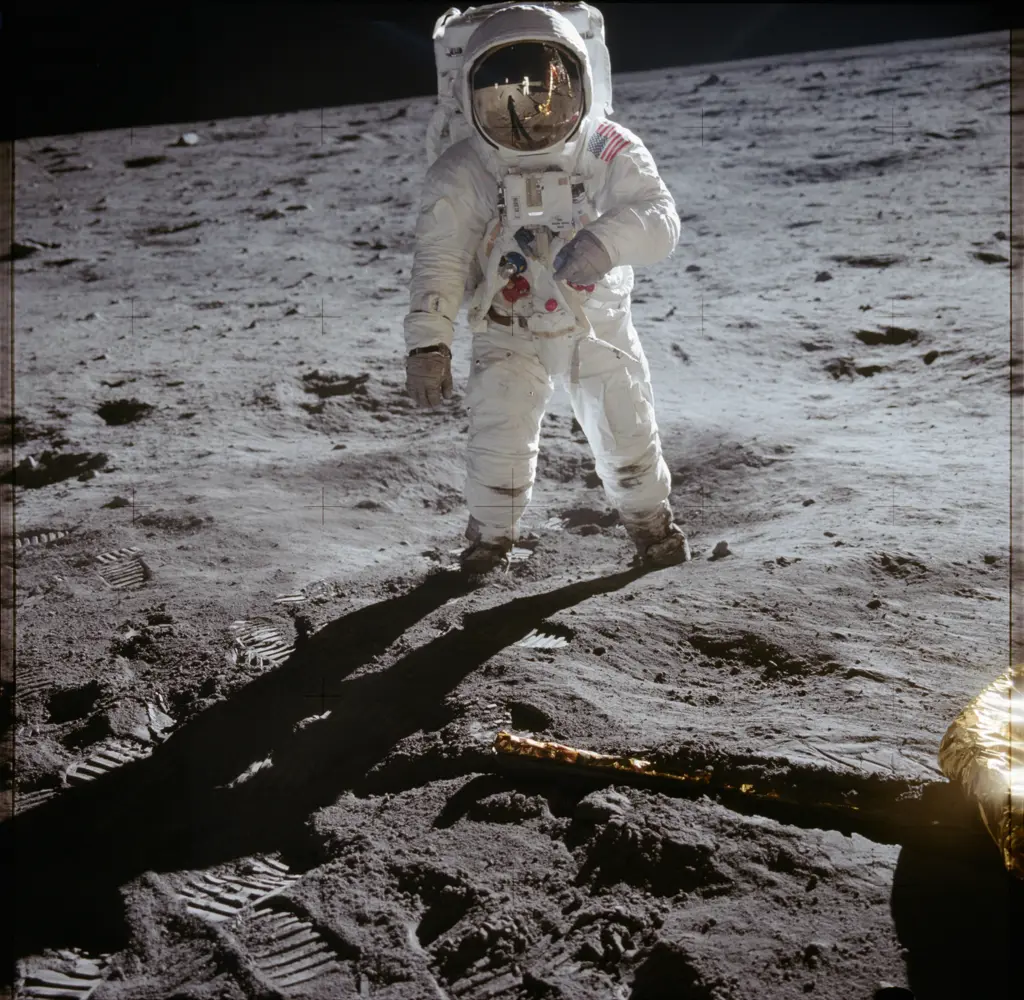

Apollo Program
RetiredLanding humans on the Moon, 1969–1972
Falcon 9
OperationalSpaceX's partially-reusable workhorse — the most-flown orbital rocket in history.
Sources
- Lunar Relay Services Requirements Document (SRD) — NASA
- LunaNet Interoperability Specification v5 — NASA
- LANS Interoperability Demo (SpOps 2025) — NTRS
- LunaNet — Wikipedia
- Exploration and Space Communications: LCRNS — NASA
- LunaNet Overview for ICG-IOAG Cislunar PNT Workshop (Feb 2025)
- Japan Lunar Navigation Satellite System (LNSS) — UNOOSA
- Onboard Processing for LunaNet Data Services — IEEE Xplore
- LunaNet: Crafting the Navigation and Connectivity Framework — Aerospace Corporation
- LunaNet: Empowering Artemis with Communications and Navigation Interoperability — NASA
- ispace-U.S. Announces Official Launch of Data Relay Service
- LunaNet Interoperability Specification — NASA SCaN
- Moonlight: LCNS and Lunar Pathfinder — UNOOSA
- Moonlight Programme — Wikipedia
- Moonlight — Telespazio
- LunaNet: Interoperability for Lunar PNT — UNOOSA/ICG-17