Surface comms
How spacecraft on other worlds talk to Earth — the orbiting relay nodes, frequency bands, and coverage architectures that bridge the void.
Surface-to-Orbit Relay Systems
A surface communications relay is a spacecraft or network of spacecraft that forwards radio signals between users on or near a planetary surface — rovers, landers, crewed vehicles, astronauts — and ground stations on Earth or another hub. Rather than relying on brief, geometry-dependent direct-to-Earth windows, relay architectures route traffic through an intermediate node in orbit, dramatically increasing coverage time and achievable data rates.
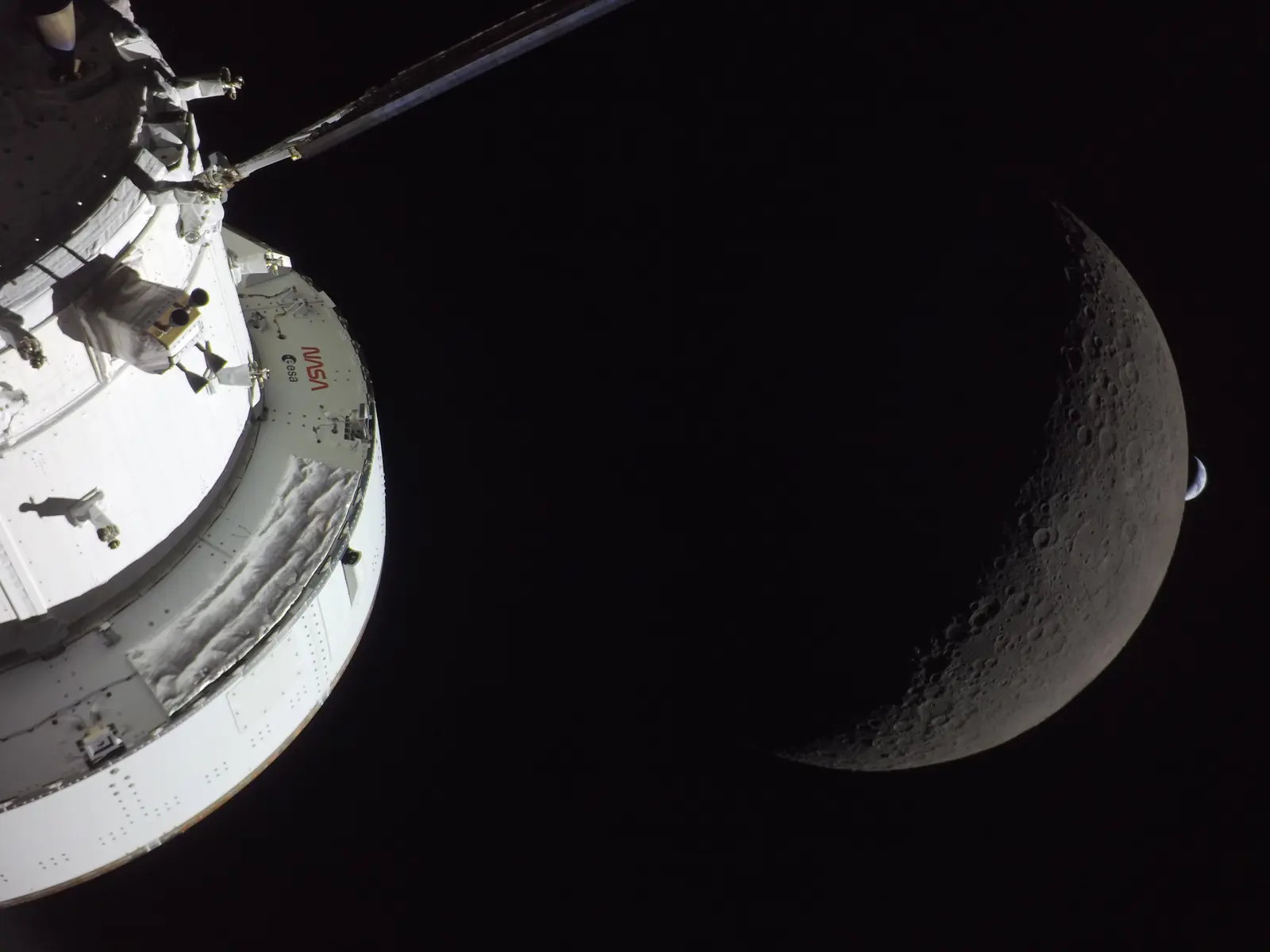
The principle applies across the Solar System. Around Earth, geosynchronous relay satellites such as NASA's Tracking and Data Relay Satellite System (TDRSS) keep the International Space Station in near-continuous contact with mission control. At Mars, an international constellation of orbiters relays gigabits of science data from rovers such as Perseverance each week. On the Moon, NASA, ESA, JAXA and commercial providers are building a new lunar relay and navigation framework — LunaNet — to serve Artemis-era surface missions and the far side of the Moon.
The common engineering trade-off in all relay systems is altitude versus footprint: higher orbits give each node a larger coverage area but increase path loss and round-trip latency. Three well-placed geostationary nodes can provide near-global continuous service to low-Earth-orbit users; a handful of orbiters at Mars can give a rover dozens of relay passes per week; a purpose-designed lunar constellation can cover the south pole for Artemis surface operations.
How Relay Coverage Works
Coverage range in a relay system is set primarily by orbital geometry. For a satellite in circular orbit, the instantaneous surface footprint — the region from which the satellite is visible above a minimum elevation angle — grows with altitude. A low-Earth-orbit relay at 160–2,000 km altitude is visible from within roughly 1,000 km of the point directly beneath it, but it moves quickly: a typical LEO orbital period is about 90 minutes, so any fixed ground point sees it for only a few minutes per pass. To achieve uninterrupted connectivity using LEO relays, a constellation of many satellites is required.
Medium-Earth-orbit (MEO) satellites cover a larger regional footprint and stay in view of a ground point longer, so fewer nodes are needed for continuous coverage of a given area, at the cost of somewhat higher path loss and time delay. MEO is commonly used for navigation constellations (GPS, Galileo), and the same geometry applies to communications relay networks.
Geostationary orbit at approximately 35,786 km altitude allows a satellite to remain fixed over a single point on the equator. Each GEO node can see roughly one-third of Earth's surface given practical elevation-angle limits. A standard three-satellite GEO constellation spaced about 120° apart in longitude provides near-global coverage — excluding extreme polar regions — on a 24/7 basis for low-Earth-orbit users and ground stations. NASA's TDRSS is the operational example: with three primary GEO nodes positioned over the Atlantic, Pacific, and Indian Ocean regions, the system delivers near-continuous relay service to missions such as the International Space Station and Hubble Space Telescope. TDRSS currently operates nine satellites on orbit, with three serving as primary operational nodes.
A single GEO relay satellite can support links to spacecraft in the 200–1,200 km altitude band over its footprint on a continuous basis. To close coverage gaps at very low altitudes or polar regions, a third GEO node and associated ground station can eliminate the Zone of Exclusion that would otherwise affect low-altitude users. Ground stations for TDRSS are located at White Sands, New Mexico and Guam.
Lunar Relay Architecture: LunaNet
For the Artemis program and broader cislunar exploration, NASA, ESA, and JAXA are jointly defining LunaNet — an overarching communications and positioning, navigation, and timing (PNT) framework for lunar infrastructure. The central standard is the LunaNet Interoperability Specification (LNIS), which defines interfaces and services for lunar relay and navigation systems and must be adopted by all participating nodes.
Three regional relay programs are expected to contribute to a combined constellation. NASA's Lunar Communications Relay and Navigation Services (LCRNS) will incrementally launch multiple relay satellites to phase in coverage of the lunar south pole region, providing increasing data-rate and PNT capability over time. ESA's Moonlight initiative (LCNS) contributes lunar relay nodes including the first-generation Lunar Pathfinder spacecraft, which carries S-band and UHF links to lunar surface and orbital assets plus an X-band link for the Earth segment. JAXA's Lunar Navigation Satellite System (LNSS) forms a third contributor. Together these nodes will broadcast a common Authentication and Forwarding Signal (AFS), forming the Lunar AFS Network Service (LANS) that enables surface users to derive position fixes.
The south-pole service volume drives PNT constellation requirements. At Initial Operating Capability – Charlie phase, at least four AFS links must be simultaneously in view with a Geometric Dilution of Precision below 6 for at least 40% of an Earth day over the south pole. Each LCRNS AFS transmitter must meet a signal-in-space position error of 13.43 m (3σ). A planned interoperability demonstration will involve one ESA Moonlight node, one JAXA LNSS node, and at least two NASA LCRNS nodes, with a later phase adding at least three AFS transmitters from different orbital nodes.
Gateway as a Lunar Relay Node
NASA's Gateway lunar outpost doubles as a high-capacity relay node for surface and cislunar missions. Gateway provides relay communication paths and radiometric tracking between crewed and robotic systems on the lunar surface or in cislunar space. Its communications platform carries medium-rate X-band and high-rate Ka-band links directly to and from Earth for communication and ranging with NASA and international ground stations, alongside S-band and Ka-band lunar links for missions in cislunar space or on the surface. A short-range S-band subsystem supports visiting vehicle rendezvous and proximity operations. The system supports at least three simultaneous links, enabling concurrent relay for multiple lunar systems.
The Power and Propulsion Element (PPE) lunar links support data rates of up to 10 Mbps uplink (from a lunar system to Gateway) and 1 Mbps downlink (from Gateway to a lunar system), and Gateway can relay HD video from Earth to lunar systems over these links. ESA's Esprit communications module enhances this further: two independently rotatable antennas allow Esprit to simultaneously track a rover on the lunar surface while communicating with an approaching Orion spacecraft. Esprit is designed to support the ESA Argonaut lunar lander during landing — relaying live video — and provides encrypted data transfer rates of up to 25 Mb/s, sufficient for 4K video streaming from the Moon.
Mars Relay Network
At Mars, surface communications are built around a two-hop relay architecture. Surface assets — rovers such as Perseverance and Curiosity — transmit science data to passing Mars orbiters using UHF proximity links governed by the CCSDS Proximity-1 protocol at rates of up to about 2 Mbps. The orbiters then relay the accumulated data to Earth via X-band or Ka-band links received by NASA's Deep Space Network, which operates antenna complexes in California, Spain, and Australia, and by ESA's ESTRACK network. This decouples surface communications from the power and antenna constraints of a direct-to-Earth link, enabling data volumes that direct transmission alone could not support.
The Mars Relay Network (MRN) is a multi-agency international constellation of five orbiters providing relay services to surface missions. Current members are NASA's Mars Reconnaissance Orbiter, Mars Odyssey, and MAVEN, plus ESA's Mars Express and ExoMars Trace Gas Orbiter. All carry UHF relay radios and antennas compatible with Proximity-1. The MRN provides multiple relay sessions per sol from these near-polar or high-inclination orbiters, returning rover data to Earth roughly a dozen times per week. Individual passes last minutes and deliver data measured in gigabits. Coverage is intermittent on short timescales but regular and predictable over days through planning and scheduling. A 2025 MRN Participation Guide formalizes service interfaces for new relay providers and users, emphasizing adherence to CCSDS standards and cross-agency coordination.
Earth–Mars latency is governed by the interplanetary distance: one-way signal travel time ranges from about 4 minutes at closest approach to about 24 minutes when Mars is farthest from Earth. This delay dominates relay timing characteristics regardless of whether an orbiter relay or direct-to-Earth link is used. Looking ahead, planning for human Mars exploration envisions a dedicated Mars Telecommunications Network (MTN) that treats Mars communications as a utility layer analogous to GPS or the Deep Space Network. The first MTN orbiter is expected to launch no earlier than the end of 2028 with a design lifetime of around five years.
Surface Node RF Coverage Engineering
For relay nodes located on a planetary surface — fixed repeaters extending coverage to nearby rovers, astronauts, or sensors — the coverage radius is set by terrain, antenna height, frequency choice, and link budget. On airless or near-airless worlds such as the Moon or Mars, propagation is close to free-space with terrain blocking as the dominant constraint. At UHF frequencies (around 400–450 MHz, matching current Mars proximity links) some diffraction over modest obstacles occurs; S-band (2–4 GHz) is more strictly line-of-sight but supports higher data rates.
A surface relay node covering a local area — on the order of tens of kilometers radius — would typically provide an access link to nearby users at UHF or S-band using sector or omnidirectional antennas, combined with a higher-gain X-band or Ka-band backhaul antenna pointed toward an orbiter or base station. Elevating the relay antenna on a mast significantly extends the RF horizon. Multiple surface nodes can be arranged in a cellular pattern so that rovers or astronauts moving between coverage zones remain connected. For sparse networks where continuous uplinks to orbiters are not always available, Delay-Tolerant Networking protocols using store-and-forward bundle routing allow data to move reliably through the network even during contact gaps.
2023–2024 Milestones in Surface Relay
- Mar 2024China launches QueQiao-2
QueQiao-2 entered a lunar elliptical frozen orbit, supported the Chang'e-6 mission, and is intended to serve follow-on Chinese lunar missions.
- 2024NASA Skylight optical crosslink demonstration
NASA's Skylight Laser Communication Terminal successfully established an optical crosslink between two CubeSats, advancing laser relay toward operational relevance.
- Nov 2024NASA TDRS commercialization strategy confirmed
NASA announced that its legacy TDRS fleet would continue supporting existing missions while new missions would transition to future commercial relay services.
- 2024–2025ispace-U.S. data relay service announced
ispace-U.S. announced a lunar data relay service based on two relay satellites to be deployed during Mission 3 in 2026, targeting far-side lunar lander communications.
- 2023Commercial relay capabilities expand
Viasat was developing Real-Time Space Relay (Ka-band) and InCommand (L-band) services; Viasat and Addvalue's joint IDRS provided an operational in-space relay capability.
- 2025MRN Participation Guide released
NASA released the Mars Relay Network Participation Guide (initial release, July 2025), formalizing interfaces, standards, and coordination processes for current and future relay providers.
Surface Relay FAQ
Related

Artemis Program
OperationalReturning humans to the Moon — to stay


Perseverance Rover
OperationalHunting for ancient life in Jezero Crater


Apollo Program
RetiredLanding humans on the Moon, 1969–1972


Mars
The fourth planet from the Sun — a cold, rocky desert world with the Solar System's tallest volcano, two tiny moons, and abundant evidence of an ancient watery past.


The Moon
Earth's only natural satellite — a world of craters, ancient volcanoes, and frozen water that shapes our tides, steadies our seasons, and beckons a new generation of explorers.


International Space Station
Humanity's permanent outpost in low Earth orbit — a football-field-sized laboratory that has hosted nearly 300 people from 26 countries without interruption since November 2, 2000.
Sources
- Space Communications: 7 Things You Need to Know — NASA
- Communications satellite — Wikipedia
- Lunar Relay Services Requirements Document (SRD) — NASA
- A Communications Platform for Lunar Exploration — NASA NTRS
- LANS Interoperability Demo — NASA NTRS (SpOps 2025)
- Esprit reviews for Gateway — ESA Exploration Blog
- Lunar Communications and Navigation Architecture — NASA
- Lunar Pathfinder — eoPortal
- Design and Architecture of the Mars Relay Network Planning and Scheduling System — AIAA
- The Mars Relay Network Connects Us to NASA's Martian Explorers — iconnect007
- Mars Relay Network — NASA Science
- The Mars Relay Network Participation Guide — NASA
- Why Mars Gets a Network and the Moon Gets a Market — Adithya Pani / Substack
- An Assessment of Different Relay Network Topologies to Improve Earth–Mars Communications — ScienceDirect
- Relay Satellite — ScienceDirect Topics
- Tracking and Data Relay Satellite System — Wikipedia
- Tracking and Data Relay Satellites — NASA
- NASA's Laser Communications Relay Demonstration — BIS Research
- ispace-U.S. Announces Official Launch of Data Relay Service
- Shaping the Future of Space-to-Space Relay Communication — techUK
- Current Situation and Envision of Deep Space Exploration in China (QueQiao-2) — UNOOSA