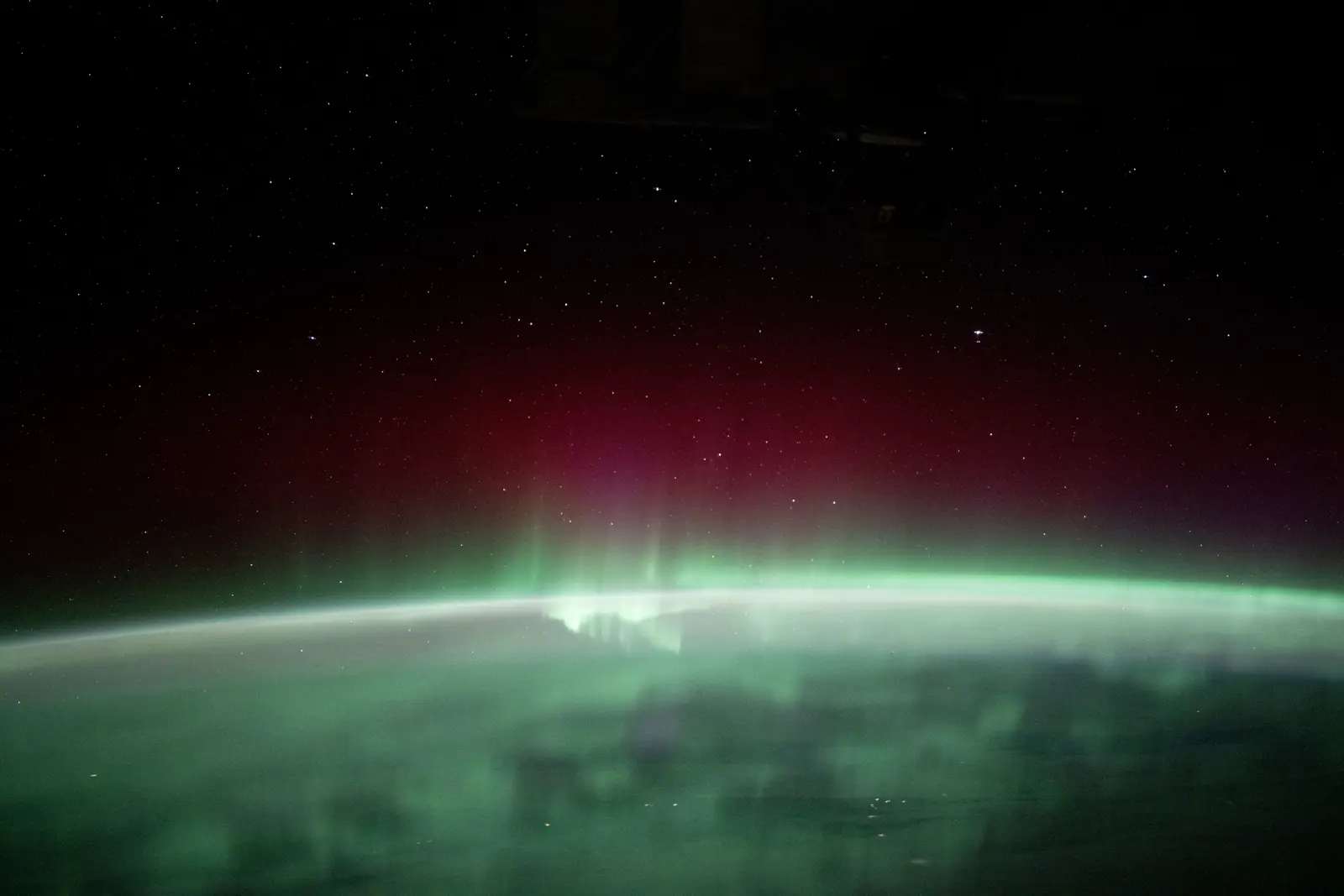
Aurora
The shimmering light show born where the Sun's reach meets Earth's magnetic shield — and found across the Solar System.
Aurora
An aurora is a natural luminous display in the upper atmosphere, produced when charged particles from the Sun are guided by a planet's magnetic field into the polar regions and collide with atmospheric gases. On Earth the phenomenon is called aurora borealis in the northern hemisphere and aurora australis in the southern hemisphere — mirror-image light shows driven by identical physics. The two names reflect the Latin word for dawn (aurora) and the Greek words for north wind (Boreas) and south (Australis).
Auroras appear in a wide variety of forms — arcs, curtains, rays, patches, and bands — aligned roughly east–west around an oval that encircles each magnetic pole. The displays are most reliably seen within this auroral oval, which stretches over high-latitude regions including Canada, Alaska, Iceland, northern Scandinavia, Russia, and southern Greenland, and its counterpart in Antarctica and surrounding ocean latitudes. During intense geomagnetic storms the oval expands dramatically toward the equator, and auroras have been observed as far south as the tropics.
Although the phenomenon is most familiar on Earth, auroras have been firmly detected on every outer planet in the Solar System — Jupiter, Saturn, Uranus, and Neptune — as well as on Mars and Venus, and aurora-like emissions have even been observed on a brown dwarf roughly 18 light-years away. The study of auroras has grown from ancient myth and early natural philosophy into a precise branch of space physics, providing a window onto the Sun–Earth connection, the structure of planetary magnetospheres, and the behaviour of the upper atmosphere.
Formation: how auroras are made
The Sun continuously emits the solar wind — a stream of charged particles and plasma flowing outward through the Solar System. During periods of heightened solar activity, particularly around solar flares and coronal mass ejections (CMEs), the solar wind intensifies and can disturb Earth's magnetosphere. Under normal conditions the magnetosphere deflects most of this particle flow around the planet, but at the polar regions, where magnetic field lines converge and dip toward the surface, some charged particles — mainly electrons and protons — are funnelled inward along those lines and descend into the upper atmosphere.
As these energetic particles collide with atoms and molecules of oxygen and nitrogen, they transfer energy to the gas, exciting the electrons of those atoms to higher energy states. When the electrons return to their ground states they release that energy as photons of light — producing the glow of the aurora. The process is analogous to what happens inside a fluorescent tube or neon lamp, with the atmosphere itself acting as the luminous medium.
Because the magnetic field acts as a guide rather than a uniform funnel, the aurora forms not at a single point but along an auroral oval — a roughly circular band around each magnetic pole. When geomagnetic activity increases, this oval expands toward lower latitudes, bringing auroras into view for observers far from the polar regions. Auroral activity is strongly tied to the Sun's approximately 11-year cycle, peaking near solar maximum when solar flares and CMEs are most frequent and powerful.
Colors, altitudes, and the physics of emission
The color of an aurora is not arbitrary: it is determined by which atmospheric gas is being excited, at what altitude, and by the quantum properties of the specific electronic transition involved. The result is a layered structure in which different colors dominate at different heights.
Green is by far the most common auroral color, appearing in roughly 90 percent of visible displays. It is produced by atomic oxygen emitting at a wavelength of 557.7 nm — the OI green line — at altitudes of approximately 100 to 200 km, with the greatest intensity around 110 to 150 km. The excited state responsible for this emission has a lifetime of roughly 0.7 seconds; below about 95 km the atmosphere is dense enough that collisions de-excite the oxygen atom before it can radiate, quenching the green line. Combined with the human eye's peak sensitivity near 555 nm, this makes green both the physically dominant and perceptually brightest color in most auroral scenes.
Red auroras arise from the same species — atomic oxygen — but via a different metastable transition at 630.0 nm. This excited state has a lifetime of approximately 100 seconds, meaning it requires very low collision frequencies to survive long enough to emit. That condition is only met at altitudes of roughly 200 to 300 km and above. Entirely red displays are rare, particularly at lower latitudes, but red tops or caps above green curtains are a more common sight during active storms.
Blue, violet, and purple hues are produced by molecular and ionized nitrogen (N2 and N2+). The first negative system of N2+ emits prominently near 391 nm and 428 nm in the blue-violet, while N2's second positive system contributes bands spanning red to blue that together often appear visually purple. These emissions occur predominantly below about 100 km, where nitrogen is abundant and fast-radiating nitrogen band systems can still emit before collisional quenching. Pure blue aurora is extremely rare; violet or purple fringes appear more often along the lower edges of bright curtains during intense geomagnetic storms.
Pink and magenta bands, frequently seen as a narrow fringe beneath green curtains during strong storms, result from the combined emission of blue-violet nitrogen and green or red oxygen light. They are most prominent at the lowermost border of bright auroras, typically below 100 km. The overall auroral spectrum is therefore a superposition of discrete atomic oxygen lines at 557.7 and 630.0 nm and structured molecular nitrogen band systems in the blue-to-red range — a line-and-band spectrum that serves as a precise diagnostic of upper-atmospheric composition and the altitude of particle precipitation.
From ancient records to space physics
- c. 977–957 BCEEarliest datable written record
The Chinese Bamboo Annals describe a five-colored light in the northern sky, widely cited as the earliest datable written aurora record.
- 4th century BCEAristotle's luminous sky
The Greek philosopher Aristotle described a peculiar glow comparing it to earthly fire — an early natural-philosophical account of an auroral display.
- 34 CERoman alarm at Ostia
Roman troops were reportedly dispatched toward Ostia after an intense red aurora was mistaken by Emperor Tiberius for the town being on fire.
- 1619Galileo Galilei names the aurora borealis
Galileo coined the term aurora borealis from the Latin for dawn and the Greek name for the north wind. He incorrectly proposed that the lights were sunlight reflected from the upper atmosphere.
- 1716Edmond Halley and the geomagnetic hypothesis
Following an intense auroral display over London, Halley proposed that auroras were luminous phenomena in the upper atmosphere aligned with Earth's geomagnetic field lines — the first connection between aurora and terrestrial magnetism.
- 18th centuryBenjamin Franklin's electrical theory
Franklin argued that auroras were caused by electrical charges concentrated near the poles, foreshadowing later particle and electric-current models.
- 1 Sep 1859The Carrington Event
British astronomer Richard Carrington observed the first recorded solar flare — a sudden brightening over a large sunspot. Within about a day, a massive geomagnetic storm produced brilliant red, green, and purple auroras visible into the tropics and severely disrupted telegraph systems worldwide, firmly linking solar activity to geomagnetic storms and auroras.
- 1882–1885Sophus Tromholt and the First International Polar Year
Danish astrophysicist Sophus Tromholt participated in the First International Polar Year (1882–1883), established an auroral observatory in Kautokeino, Norway, and around 1885 is credited with taking one of the first successful photographs of the aurora.
- 1899–1903Kristian Birkeland's Arctic expeditions
Norwegian physicist Kristian Birkeland led expeditions north of the Arctic Circle starting in 1899, deploying magnetic and optical instruments to study auroras in situ. He documented the correlation of auroral displays with geomagnetic disturbances and developed the particle-beam theory of aurora production.
- Early 1900sBirkeland's terrella experiments
Using a magnetized metal sphere called a terrella, bombarded with cathode-ray electrons in a vacuum chamber, Birkeland reproduced aurora-like luminous ovals near the magnetic poles. He proposed that charged particles from the Sun, guided by Earth's magnetic field, precipitate into the polar atmosphere — the foundation of the modern particle-precipitation model and of what are now called Birkeland currents.
- 1960s–1980sMagnetospheric missions confirm the solar-wind model
Dedicated space missions mapped Earth's magnetosphere, radiation belts, and auroral substorms, verifying that energy stored in the magnetic tail during strong solar-wind periods is explosively released and directed into the auroral zones.
- 1979Voyager 1 images auroras on Jupiter
NASA's Voyager 1 imaged auroras on the dark side of Jupiter, demonstrating that auroral processes occur on magnetized planets beyond Earth.
- 1980sVoyager 2 detects auroras at Uranus and Neptune
Flyby observations by Voyager 2 provided the first evidence of auroral emissions at Uranus and Neptune, revealing that both ice giants, despite their unusual tilted and offset magnetic fields, support auroral activity.
Space weather forecasting and the Kp index
Because auroras are driven by solar activity, forecasting when and where they will appear is fundamentally a space-weather problem. The primary tool used by operational centers worldwide is the planetary Kp index — a dimensionless 3-hourly measure from 0 to 9 of disturbances in Earth's magnetic field, derived from a network of mid-latitude magnetometers. Values of 0–1 indicate very quiet conditions; 2–3 unsettled; 4 active; and Kp 5 or above constitutes a geomagnetic storm. NOAA maps Kp onto a G-scale for public communication: Kp 5 = G1 (minor), Kp 6 = G2 (moderate), Kp 7 = G3 (strong), Kp 8–9– = G4 (severe), and Kp 9o = G5 (extreme).
Higher Kp values correspond to a larger, more equatorward auroral oval, making Kp a practical visibility proxy. As a rough European guide, a Kp of 5 brings aurora to northern Scotland and southern Scandinavia; Kp 7 reaches northern England and northern Germany; Kp 9 can make the lights visible from southern England and central France. In the southern hemisphere, a Kp of 3 may suffice for southern Tasmania, while Kp 5 can bring aurora to the Victorian coastline and Kp 9 pushes it into the tropics.
Operational aurora forecasting works in three layers. The most immediate is nowcasting — using real-time solar-wind and interplanetary magnetic field (IMF) data from spacecraft at the Sun–Earth L1 point, combined with auroral imagery, to provide short-term probability estimates and oval locations. NOAA's 30-minute aurora forecast is the principal operational product at this timescale. Short-term forecasts of 0–3 days are built from CME tracking, coronal-hole high-speed stream modeling, and propagation models; NOAA SWPC's 3-day Kp and G-scale forecast is the standard reference. Longer outlooks to about 27 days exploit the Sun's rotation period and the recurrence of coronal holes, but are treated as trend indicators rather than precise predictions.
Besides Kp, skilled observers and automated tools also monitor solar-wind speed and density and especially the north–south component of the IMF, called Bz. A sustained southward Bz strongly favors geomagnetic activity and aurora because it allows efficient energy transfer from the solar wind into the magnetosphere. M- and X-class solar flares are tracked for their associated CMEs, with estimated arrival times at Earth providing a warning window of roughly one to three days.
Notable recent events: 2024–2025 solar maximum
Solar cycle 25 reached its peak around 2024–2025, producing a run of significant geomagnetic storms that brought auroras to latitudes not commonly reached in recent decades. The most remarkable was a series of fast CMEs from an unusually active sunspot region in early May 2024 that drove conditions to Kp 9 (G5 — extreme), the highest category on NOAA's scale. Operational Kp logs recorded multiple consecutive 3-hour intervals at Kp 8–9 during this period, and auroras were photographed across the continental United States, large parts of Europe, and comparable mid-latitudes in Asia. The event was widely described by operational space-weather centers as the strongest geomagnetic storm since at least the Halloween storms of 2003.
Across the remainder of 2024, several additional CME-driven storms reached Kp 7–8 (G3–G4), producing reliable mid-latitude auroras across North America and Europe. These events typically followed M- or X-class flares recorded in GOES X-ray flux data, with associated Earth-directed CMEs arriving after propagation times of one to three days. Throughout 2025, with solar activity remaining elevated, recurrent coronal holes and further CMEs generated multiple moderate-to-strong storms (Kp 6–7, G2–G3), and persistent coronal-hole streams contributed extended periods with Kp 4–5 or above.
Auroras beyond Earth
Every planet in the outer Solar System with a strong magnetic field supports auroral activity, though the physics differs substantially from planet to planet. Auroras have also been detected on bodies without global dipole fields — Mars and Venus — driven by crustal or induced magnetic fields and solar-wind interactions. Even a nearby brown dwarf approximately 18 light-years away shows a bright red aurora, demonstrating that auroral processes extend to substellar objects.
Jupiter hosts the most powerful auroras in the Solar System — up to roughly 1,000 times brighter than Earth's. They are dominated by far-ultraviolet and infrared emissions largely invisible to the human eye, and also produce strong radio signals. Crucially, Jupiter's auroras do not depend solely on the solar wind: the planet's rapid rotation and enormous magnetosphere generate intense auroral activity even during periods of weak solar-wind input. A major additional energy source is the plasma torus created by volcanic material from the moon Io, which is ionized, trapped in Jupiter's magnetosphere, and drives vivid auroral footprints where the field lines connecting to Io, Europa, and Ganymede intersect the Jovian atmosphere. Hubble Space Telescope UV imaging and in situ measurements by the Voyager and Juno missions have provided detailed maps of Jupiter's persistent main oval and moon-associated auroral spots.
Saturn also produces impressive auroras, brighter than Earth's though far less powerful than Jupiter's, and strongest in UV and infrared. Occasional visible-light observations have recorded pink glows with purple streaks. Saturn's auroras are primarily solar-wind-driven but receive additional contributions from plasma sourced by its moons and rings — notably from the geysers of Enceladus — and wrap around the poles as glowing rings sometimes punctuated by spots linked to moon-magnetosphere interactions. Cassini's multi-spectral observations provided the most detailed characterisation of their morphology and variability.
Uranus and Neptune both have strongly tilted and offset magnetic fields — their dipole axes are significantly misaligned from their rotation axes and displaced from the planetary centres — which means their auroras can appear at unusual latitudes rather than forming tidy polar ovals. At the great distances of these ice giants from the Sun, the solar wind is weaker, and the resulting auroras are faint and detected primarily in ultraviolet. Voyager 2 provided the first evidence of auroral emissions at both worlds during its flybys; subsequent Hubble UV imaging has added limited further detections. Both remain poorly understood compared with the gas giants.
Beyond the giants, auroral-like glows have been identified on Mercury and on comet 67P/Churyumov-Gerasimenko, further expanding the known range of auroral environments in the Solar System.
What aurora science has revealed
Each auroral color maps to a specific gas, altitude, and atomic transition: green oxygen at 100–200 km (557.7 nm), red oxygen above 200 km (630.0 nm), and blue-violet nitrogen below 100 km. The layering is controlled by collision frequency and the lifetimes of metastable excited states.
Kristian Birkeland's early 20th-century experiments predicted field-aligned electrical currents flowing between the magnetosphere and the ionosphere. Now named Birkeland currents, they were confirmed by satellite measurements and are understood as a fundamental channel through which energy from the solar wind is delivered to the upper atmosphere.
Richard Carrington's observation of the first recorded solar flare on 1 September 1859, followed within a day by auroras visible into the tropics and worldwide telegraph disruption, established that solar eruptions could drive planetary-scale geomagnetic events — a connection that underpins all modern space-weather science.
Unlike Earth's auroras, which require solar-wind input to intensify, Jupiter's are powered largely by the planet's own rapid rotation and by the plasma torus fed by Io's volcanoes. This makes Jupiter's polar lights the most energetic auroras in the Solar System, up to 1,000 times brighter than Earth's.
Rare reports of crackling, hissing, or popping sounds coinciding with aurora are not caused by sound travelling down from the 80–200 km altitude of the lights. Research associated with Aalto University in 2012 supported the explanation that the sounds originate in a near-ground temperature inversion layer — potentially only about 230 feet above the observer — where electrical charges discharge under specific atmospheric conditions.
Mars and Venus, which lack planetary dipole fields, both show auroral phenomena driven by crustal magnetic patches or induced fields and solar-wind interactions, demonstrating that a global dipole is not a prerequisite for auroral emission.
Auroral substorms and the oval
Within the overall auroral cycle driven by the solar wind, shorter episodes called auroral substorms punctuate the display. A substorm has three phases — expansion, breakup, and recovery — during which the aurora suddenly brightens, spreads outward, and then gradually fades. Substorms are caused by the explosive release of energy stored in Earth's magnetic tail, and they can transform a quiet auroral arc into a rapidly moving, pulsating curtain within minutes.
The auroral oval itself — the ring-shaped zone where aurora is most reliably seen — is not fixed in size or shape. Under quiet conditions it hugs the magnetic poles over high-latitude regions such as Canada, Alaska, Iceland, northern Norway, Sweden, Finland, Russia, and southern Greenland in the north, and the Antarctic continent and surrounding ocean in the south. During strong geomagnetic activity the oval expands significantly. A notable 1958 storm produced a display that stretched approximately 1,250 miles from Oregon to New Hampshire. The May 2024 G5 event similarly pushed the visible oval deep into mid-latitudes on multiple continents.
Aurora FAQ
Sources
- Aurora - Wikipedia
- Aurora Australis vs Aurora Borealis - Hotel Ranga
- Aurora - Australian Antarctic Program
- Auroras - NASA Science
- How to see the Southern Lights (Aurora Australis) - Discover Tasmania
- Auroras: The Northern and Southern Lights - UCAR SCIED
- A brief history of aurora science - BBC Sky at Night Magazine
- What causes the colors of the aurora? - Webexhibits
- The Colors of the Aurora - U.S. National Park Service
- Aurora Tutorial - NOAA / NWS Space Weather Prediction Center
- Kp Index - Aurora Zone
- Planetary K-index - NOAA / NWS Space Weather Prediction Center
- Latest Conditions - Geomagnetic Indices - SWS (Australian BOM)
- Aurora Dashboard (Experimental) - NOAA SWPC
- SpaceWeatherLive - Real-time auroral activity data
- Aurora Forecast - University of Alaska Fairbanks Geophysical Institute
- Current Space Weather - ESA Space Weather Service
- What's it like to see auroras on other planets? - The Conversation
- Extraterrestrial lights - The Planetary Society
- Northern Lights on Other Planets - Perlan
- Auroras on Saturn, Uranus, and Neptune - ScienceDirect
- The Sounds of the Northern Lights - Natural Habitat Adventures
- Aurora colors guide - Aurora Forecast App
- The Southern Lights - Aurora Australis - Antarctica Guide